The patch ring math stops working at fifty endpoints
Enterprise ring guidance assumes a fleet big enough that 5% is a meaningful sample. At 50 machines, it's 2.5 boxes.
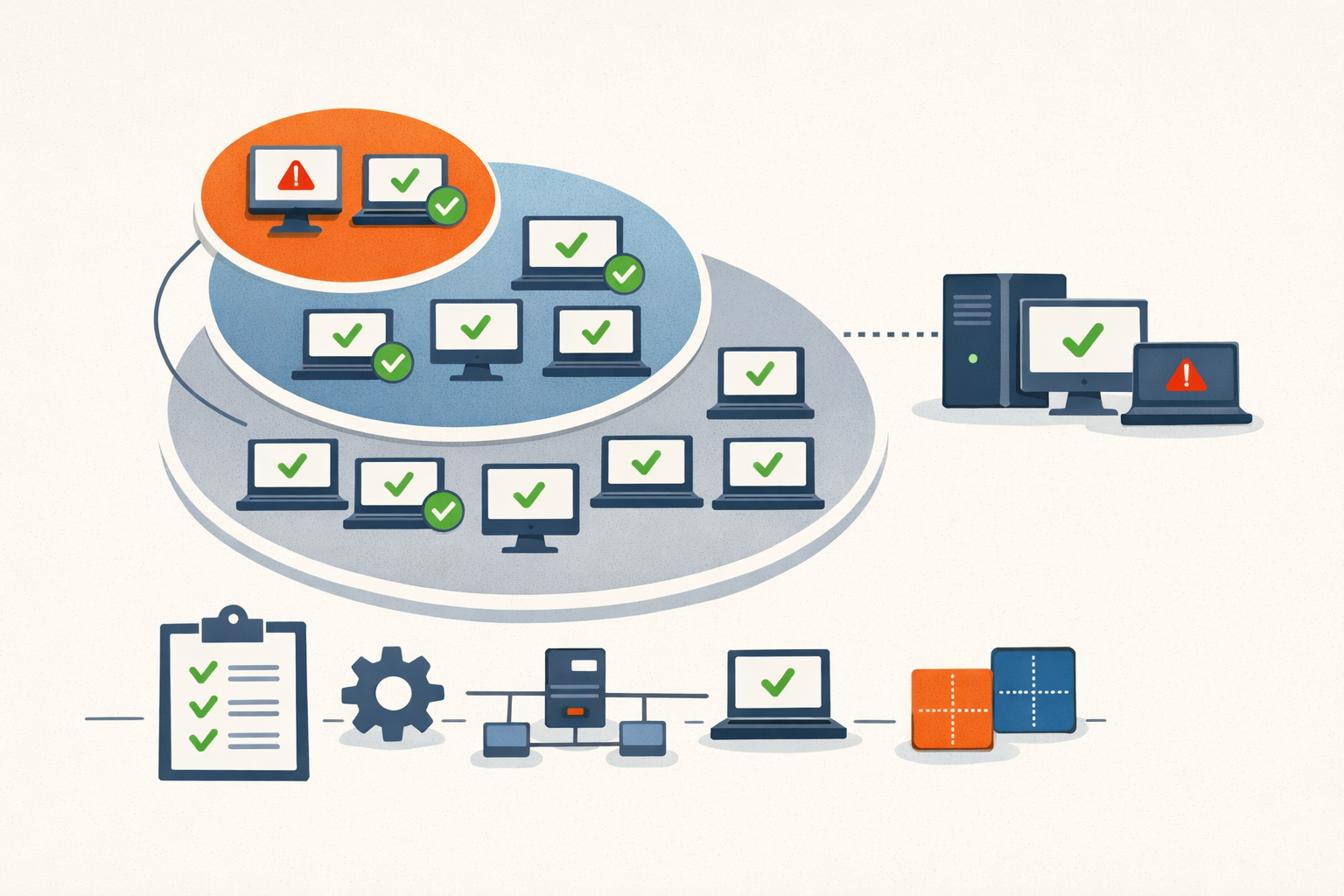
Five percent of fifty endpoints is two and a half machines. That’s the canary ring most SMB IT leads inherit when they read enterprise patch documentation, and it is the first thing that breaks when the model meets the org chart.
The obvious read is that patch rings are a solved problem. Microsoft shipped Autopatch as a managed service in July 2022, made it available to Business Premium tenants in April 2025, and NIST SP 800-40 Rev. 4 gave the canary-then-broad pattern federal policy standing in April 2022. The documentation is voluminous. The tooling is cheap or free. Action1 is free under 200 endpoints with no time limit. The ring pattern is canonical, and any competent admin can copy it.
The more interesting detail is that copying it is exactly the problem. Most published ring guidance was written for fleets where ring percentages produce meaningful sample sizes. At 50 to 500 endpoints, the percentages stop translating, and what works instead is a different design discipline that the enterprise documentation doesn’t teach.
The percentages don’t survive contact with a small fleet
Microsoft’s Autopatch defaults set Test at 0.5%, First at roughly 1%, Fast at about 9%, and Last at 90% of devices. Those numbers are coherent at 10,000 endpoints. They are nonsense at 80. A 0.5% test ring on an 80-endpoint fleet is zero machines. A 1% first ring is also zero. The math itself tells you the model was not designed for this scale.
What survives the translation is the role each ring plays, not the percentage. The canary ring exists to catch installer-level failures on a small population that includes someone who will actually open Outlook the next morning. The pilot ring exists to encounter the apps the business runs. The broad ring exists to absorb whatever the first two rings did not flag. A workable SMB structure is three rings: a canary of 5 to 10 machines mixing IT staff and friendly non-IT users, a pilot at 20 to 30% of the fleet drawn cross-departmentally, and broad covering the rest.
The composition rule is the part that gets skipped. Action1’s published ring guidance is explicit that pilot composition should include “a few tech-savvy users from different departments,” and the reason matters. IT-staff machines have atypical app footprints: admin tools, scripting environments, browser-extension dev kits, often no Acrobat license. An IT-only canary tells you whether the patch installs cleanly on a workstation running PowerShell ISE and Wireshark. It does not tell you whether it breaks the accounting team’s Excel macros, the legal team’s document-management plugin, or the dispatcher’s industry-specific app. The patch that ships clean through an IT-only canary and then takes down accounts payable is the canonical SMB ring failure.
Soak time is where the design quietly collapses
The second pattern that shows up across every source in the research is soak time treated as theatrical rather than functional. Practitioner consensus across multiple ring-deployment guides converges on 48 to 72 hours between phases. It is a minimum, not a target.
A patch that hits Ring 1 Wednesday morning and Ring 2 Wednesday afternoon is not phased. It is a faster way to break the whole fleet at once. The 48-hour floor exists because affected machines need to clear at least one normal weekday: morning reboots, full app launches, end-of-day workflows, the quirky behaviors that only surface when the machine has been awake for six hours. Compressing that to an afternoon converts the ring structure into a paperwork exercise.
Servers make the problem sharper. Server bugs surface on weekly cron jobs, month-end batch runs, and load-dependent code paths a Wednesday installer test will never touch. Folding server rings into workstation rings means a five-day server-bug latency gets compressed into a two-day workstation cadence, and the org finds out about the bug on the following Monday with everything already broken. The honest design is workstations on a three-ring schedule that completes inside a calendar week, servers on a two-ring schedule with at least a week of soak, and a documented exception list for the machines that follow neither cadence: POS terminals during retail blackouts, lab instruments, OT-adjacent endpoints.
The tooling stopped being the bottleneck
A year ago the SMB ring conversation was largely about cost. That changed in April 2025 when Microsoft made Windows Autopatch available to Business Premium and A3+ licenses, removing the E3/E5 gate. For roughly $22/user/month on a license most M365 shops already hold, the four-ring structure is now included.
The tradeoffs between SMB-priced tools cluster on two axes: how rings are defined, and whether ring promotion is gated on success signal or just on a schedule.
| Tool | Ring model | Promotion gating | Notable constraint |
|---|---|---|---|
| Windows Autopatch | Four fixed rings (Test/First/Fast/Last) | Schedule-driven, no auto success-rate gate | Included with Business Premium |
| Action1 | Lab → pilot → targeted → broad | Configurable success-rate threshold plus “first deployed X days ago” condition | Free under 200 endpoints |
| Automox | Device groups + per-group policies | Schedule-based, not threshold | Rollback via Worklet scripts, not automatic |
| NinjaOne | Device-role assignments with inherited policies | Conditional rollback on failure thresholds | Auto-trigger vs alert-then-manual unclear from docs |
| ManageEngine Patch Manager Plus | Test groups with approval gating | Manual approval workflow | Whether automated threshold gating exists is not verifiable from product docs |
| PDQ Deploy & Inventory | Collections + sequential schedules | None first-class | Ring deployment is not a named feature |
The split worth noticing is the success-gating column. Only one tool in the SMB price band promotes a ring based on outcome data rather than wall-clock time, and it’s the one that costs nothing under 200 endpoints. Everything else, Autopatch included, advances rings on schedule and assumes an admin is watching the failure rate. On a 60-endpoint fleet that admin is also the helpdesk, the network engineer, and the person who renewed the SSL cert this morning. The assumption is doing more work than it looks like.
Emergency overrides are the part that has to be designed in advance
This is where the SMB ring conversation runs into the federal-deadline conversation. CISA’s BOD 22-01 requires federal civilian agencies to remediate KEV-listed CVEs within roughly two weeks of catalog addition for post-2021 CVEs, and CSO Online reported in January 2026 that CISA is discussing cutting that to three days for critical flaws. A two-week deadline plus a normal three-ring rollout is feasible. A three-day deadline is not.
The CrowdStrike Falcon outage on July 19, 2024 is the case study for what happens when an update path bypasses the ring structure. CrowdStrike’s preliminary post-incident report acknowledges that the sensor update process did include canary-style staging, but the Rapid Response Content update that caused the outage was deployed globally without staggered rollout. The defect was live for 78 minutes, from 04:09 UTC to 05:27 UTC. An estimated 8.5 million Windows machines were ultimately affected; impact continued well past the revert because affected machines were already in boot loops by the time the fix shipped. The lesson generalizes past CrowdStrike: any update path that bypasses the ring structure is a single point of failure, whether it’s a vendor’s cloud-delivered configuration, an EDR signature push, or a Microsoft out-of-band patch.
The October 2025 KB5066835 update broke smart-card authentication and WinRE USB input; Microsoft shipped out-of-band KB5070773 for the WinRE issue, while the smart-card regression got a separate registry-based mitigation. Without a documented exception process, an org either ships the broken patch to broad or stops patching entirely. Both are bad.
The design move is to write the override down before it’s needed. A working policy: rings 1 and 2 run normal soak for everything; KEV-listed or vendor-flagged actively-exploited CVEs run on a compressed schedule (canary 4 hours, pilot 24 hours, broad next business day) with explicit named approval; anything Microsoft pushes out-of-band gets the same compressed treatment with rollback ready. The named-approval line is the part most policies skip, and it’s the part that decides whether the compression happens with a clear head or with a vendor advisory open in one tab and a CEO email in another.
What to watch
The pattern worth tracking is the gap between CISA’s deadline cadence and what SMB rings can actually deliver. A three-day KEV deadline turns the override path into the main path for any month with a serious in-the-wild CVE, and at that point the question stops being “how do we design rings” and becomes “what fraction of the year is the ring structure even in effect.” May 2026 already gave the preview: BlueHammer’s May 6 federal deadline collided with a Windows update that replaced manually-installed graphics drivers with 2024-era versions, meaning the same fleets running the emergency cadence on one CVE were rolling back a routine update on another. If 2026 brings more months like that, the answer might be uncomfortable.
The signal that would confirm this is straightforward: count the calendar days a typical SMB fleet spends running its standard ring cadence versus its emergency cadence over a 12-month window. If the emergency mode is the exception, the design is working. If it’s a third of the year, the design is fiction and the fleet is running something else entirely.
Sources
- What is Windows Autopatch? | Microsoft Learn
- Windows Autopatch FAQ | Microsoft Learn
- NIST SP 800-40 Rev. 4 (Final) | NIST CSRC
- Update Rings | Action1 documentation
- Manage Windows Update Ring Policies | Microsoft Learn
- What are Update Rings? | Action1 Blog
- Managing Groups | Automox Docs
- Windows Patch Ring Deployment Strategy | NinjaOne Docs
- ManageEngine Patch Manager Plus Pricing
- PDQ Pricing
- Known Exploited Vulnerabilities Catalog | CISA
- CISA mulls new three-day remediation deadline | CSO Online
- Falcon Content Update Preliminary Post Incident Report | CrowdStrike
- Patch Tuesday October 2025 Fail | Security Boulevard
Editor’s note (2026-08-22): Two corrections after an accuracy review. The KEV federal deadline for CVE-2026-33825 (BlueHammer) is May 6, not May 7. And out-of-band KB5070773 fixed KB5066835’s WinRE USB-input regression, not the smart-card break, which had a separate registry mitigation; our test-ring post already scoped that correctly.
Share
Related field notes
-
Edge devices need a tighter patch SLA than your servers
Vulnerability exploitation is now the top way attackers get in, and the edge is where it starts. A single blended remediation SLA prices that risk wrong. Here is the tiered math.
-
The Security Update Broke Production: A Rollback Runbook
A step-by-step runbook for when a security patch takes down production: pause the rollout, scope the damage, decide roll-back vs fix-forward, and keep the rolled-back host from becoming a silent unpatched asset.
-
When the firmware patch drops, the exploit race has already started
For internet-facing appliances, the vendor's release is the disclosure. The clock starts when the patch ships, not when CISA lists it. Here is why that changes how you rank the queue.
-
The FortiGate firmware was current. The admin password hashes were not.
FortiOS 7.2.11, 7.4.8, and 7.6.1 introduced PBKDF2 hashing for administrator accounts. The migration is per-login: SHA-256 hashes stay in place until each admin authenticates post-upgrade. The FortiBleed campaign in June 2026 compromised roughly 75,000 internet-facing firewalls by cracking credentials on devices that cleared the patching check.
Get the free CVE triage cheat sheet
Subscribe and we'll email you the one-page triage flow for fresh CVEs. Plus the weekly digest.
Subscribe