Your ERP is on the internet, and it's the system that cuts the checks
Security programs treat ERP as 'internal.' Oracle E-Business Suite exposes web modules to the internet by design, and CVE-2022-21587 turned one into unauthenticated code execution on the system that runs payroll, purchase orders, and the general ledger.
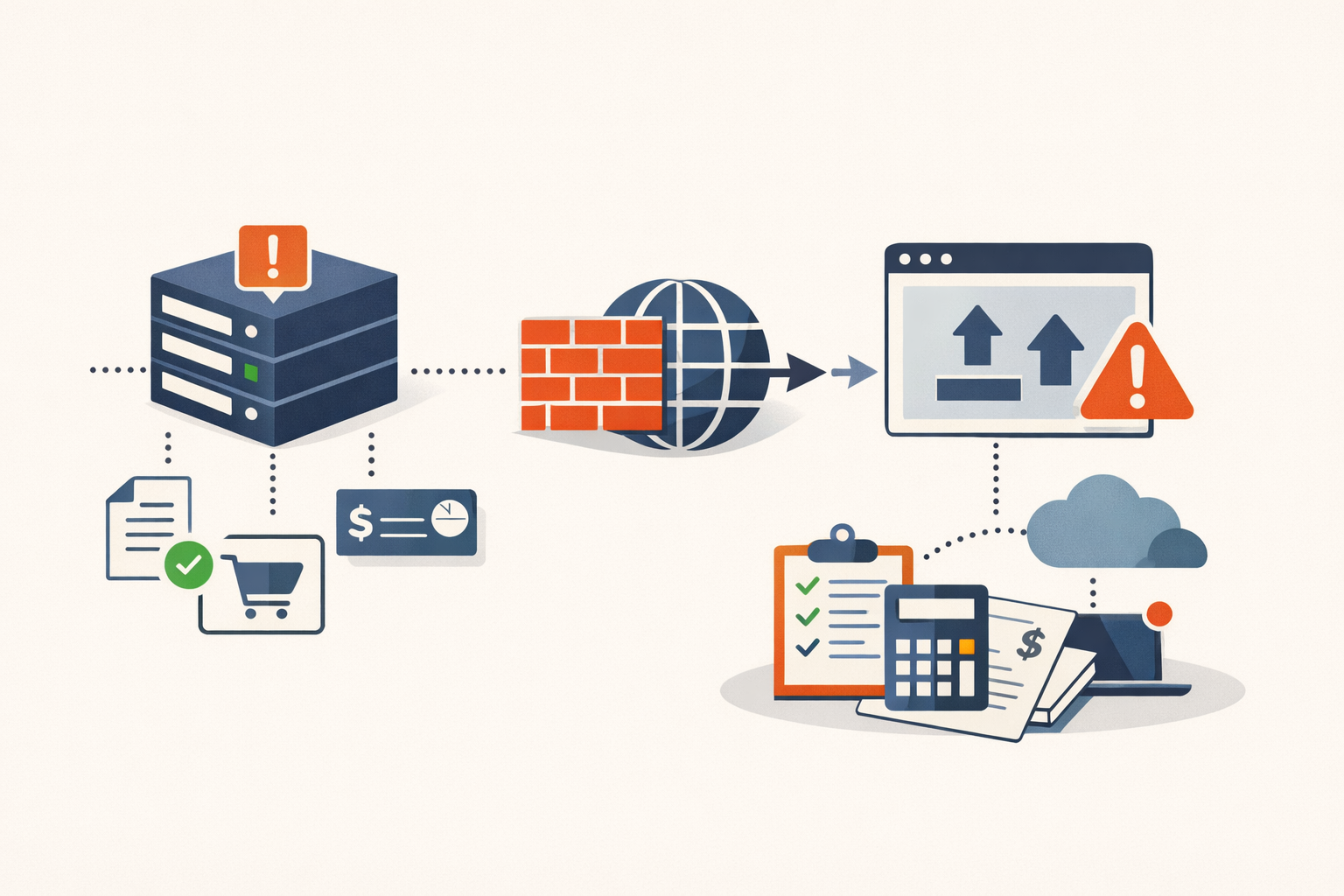
Ask a security team where their ERP sits and you’ll usually hear “internal, behind everything.” Then look at Oracle E-Business Suite, which ships internet-facing web modules, iSupplier, iStore, the Web Applications Desktop Integrator, meant to be reached by suppliers, customers, and remote staff. CVE-2022-21587 turned one of those modules into unauthenticated remote code execution, CVSS 9.8, on the system that runs the general ledger, cuts the checks, and manages payroll and purchase orders. ERP isn’t a quiet internal database. It’s a financially load-bearing application with a foot on the public internet, and that combination is what makes a bug like this serious.
What the bug is
CVE-2022-21587 is a missing-authentication file-upload flaw (CWE-306) in the Oracle Web Applications Desktop Integrator component of EBS 12.2.3 through 12.2.11. The mechanism is a ZipSlip: the BneMultipartRequest class uudecodes uploaded content and then unzips it, and the unzip step concatenates the archive’s filenames onto the target path without validating them, so an entry named with traversal sequences writes outside the intended directory. An unauthenticated attacker uploads a crafted archive and drops a JSP or Perl backdoor into a web-reachable location, achieving code execution. Oracle patched it in the October 2022 Critical Patch Update. Viettel Security published a root-cause analysis in January 2023, a Metasploit module followed, and CISA added it to the Known Exploited Vulnerabilities catalog on February 2, 2023, with the ransomware flag. Observed exploitation included enrolling victim hosts into a botnet.
It’s also worth noting this wasn’t the last time EBS landed in the catalog. A later Oracle EBS flaw drove a major extortion campaign, which tells you EBS is a sustained target, not a one-off, the same recurring-RCE pattern seen in managed file-transfer products.
Why ERP compromise is its own category of bad
A compromised web server is a data and pivot problem. A compromised ERP is that plus a financial-integrity problem, and the second part is what security teams underweight. Oracle EBS is where the organization’s money moves: accounts payable and receivable, the general ledger, procurement, payroll, supplier banking details. Code execution on that system means an attacker can potentially:
- Read the financial crown jewels: vendor and customer data, banking information, payroll, and the entire transaction history.
- Commit fraud, not just theft. Unlike a stolen database, control of the system that issues payments opens the door to fraudulent purchase orders, altered payee bank details, and fake invoices, the kind of business-process fraud that’s hard to detect and directly monetizable.
- Hold the business hostage. ERP downtime stops the organization from operating, which makes it a high-pressure ransomware and extortion target.
That’s a materially different risk profile than “a web app got popped,” and it argues for treating ERP as tier-zero financial infrastructure rather than just another internal application.
What to do
- Apply Oracle Critical Patch Updates on a real cadence. CVE-2022-21587 was fixed in October 2022; the exploited population was the systems that hadn’t applied the CPU. Oracle’s quarterly CPUs are dense and easy to defer, but EBS is exactly the system where deferral is most expensive. Get current and stay current.
- Inventory which EBS modules are actually internet-facing, and minimize them. If you don’t need iSupplier, iStore, or the Desktop Integrator exposed externally, don’t expose them. Front necessary external modules with strong access controls and a WAF, and put everything else behind the VPN.
- Segment and monitor the ERP tier like financial infrastructure. Tight network isolation, least-privilege service accounts, and monitoring for the web/app tier spawning shells or writing unexpected JSP/Perl files. Treat anomalies on the ERP host as potential fraud-enabling intrusions, not routine alerts.
- Build financial-fraud detection alongside security detection. Because ERP compromise enables payment fraud, controls like change monitoring on vendor bank details, dual approval for payee changes, and reconciliation are part of the defense, not separate from it.
- Assume compromise on long-exposed, unpatched instances. Public exploits date to early 2023. Hunt for web shells, the botnet-enrollment scripts, and unexpected outbound connections from the EBS hosts.
The reframe is for your asset classification. ERP gets filed as “internal business software” and defended accordingly, while the product itself exposes web modules to the internet and runs the organization’s money. CVE-2022-21587 is the reminder that a bug in one of those modules isn’t a contained web incident; it’s potential code execution on the financial core, with fraud and operational-shutdown consequences on top of data theft. Patch your CPUs, shrink the internet-facing surface, and defend the ERP as the crown-jewel financial system it is. We flag the ERP and business-application entries specifically, because those are the bugs where the consequence isn’t just a breach, it’s the books.
Sources
- CISA Known Exploited Vulnerabilities Catalog
- NVD CVE-2022-21587 — 2022-10
- Oracle Critical Patch Update Advisory, October 2022 — 2022-10-18
- Rapid7: Observed exploitation of Oracle E-Business Suite vulnerability CVE-2022-21587 — 2023-02-07
- Qualys ThreatPROTECT: Oracle E-Business Suite RCE (CVE-2022-21587) — 2023-02-09
Share
Related field notes
-
Oracle blamed its customers for a zero-day it hadn't patched
Oracle's first public statement during active Cl0p exploitation told customers the breach was their fault for not applying a patch that didn't exist. The correction came Saturday night, behind a paywall.
-
Cl0p chained an Oracle EBS SSRF into a mass extortion campaign. Your patch window is 21 days.
CVE-2025-61884 is a pre-auth SSRF in Oracle E-Business Suite that Cl0p weaponized into a full RCE chain hitting 100+ organizations. Here's what patching EBS actually looks like under a KEV deadline.
-
Your attack surface isn't just port 443
CVE-2023-46604 is a perfect-10 RCE in Apache ActiveMQ. The exploit isn't a web request; it's a single message to the broker on port 61616, a port most web-focused scanning and firewalling never considers. The broker then fetches a remote XML file and runs whatever's in it.
One email, every weekday morning.
You're in. Check your inbox.