What CVE-2023-7028 says about the gap between vendor patches and your patch window
GitLab fixed a perfect-10 account-takeover bug in a day. Two weeks later, 5,379 self-managed instances were still exposed. The flaw isn't the story. The lag is.
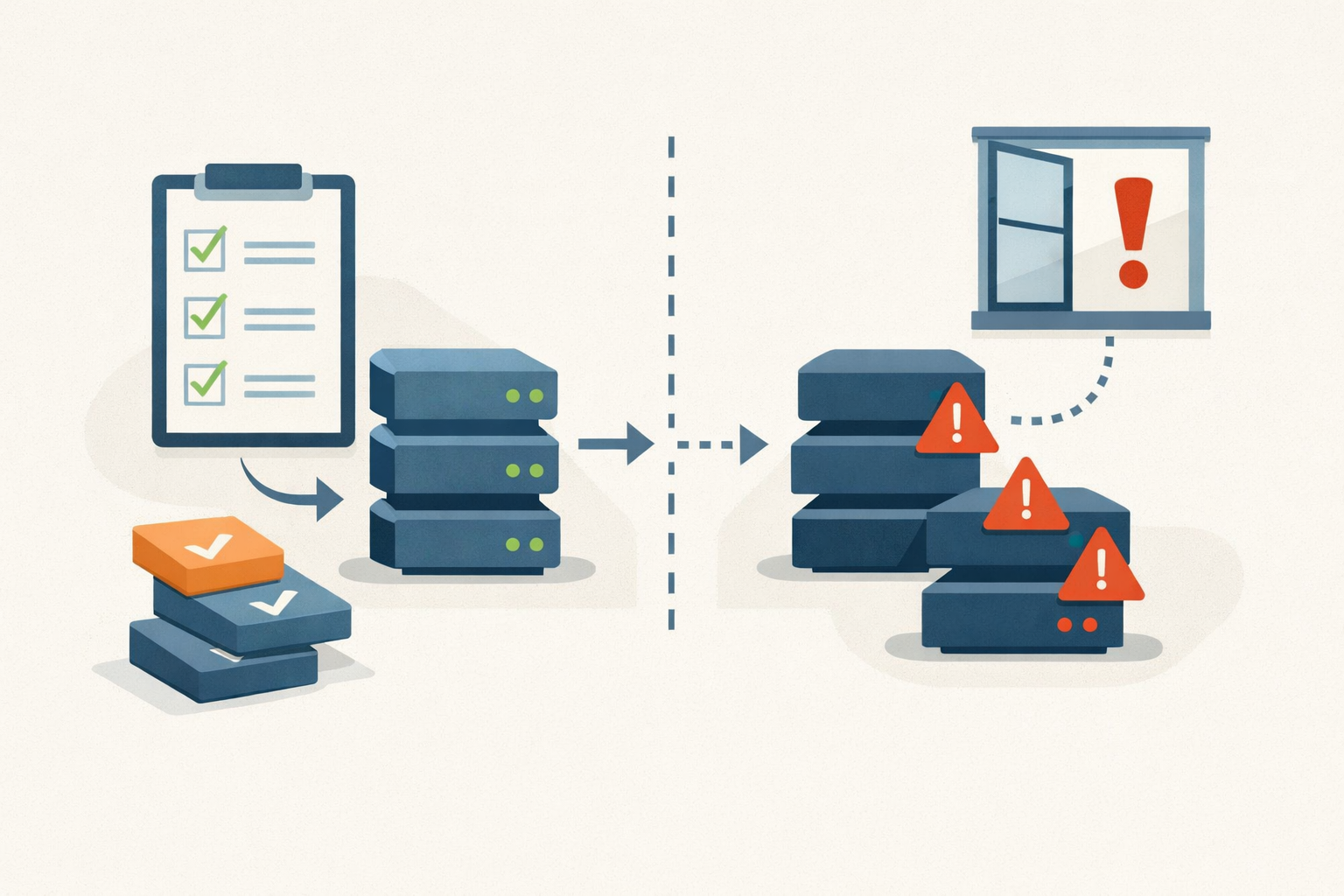
The obvious read on CVE-2023-7028 is that it was a bad bug, patched fast. GitLab scored it 10.0, shipped a fix across seven release branches at once on January 11, 2024, and patched its own hosted platform before anyone outside the company knew the flaw existed. By the textbook, that’s a vendor doing its job well. Critical severity, coordinated disclosure, fix in hand on day zero.
The more interesting detail is what happened on the other side of that fix, in the eight months before it and the months after. The bug had been live in production since GitLab 16.1.0 shipped on May 1, 2023. Proof-of-concept exploit code was public by January 15, four days after disclosure. And two weeks after the patch was available, Shadowserver still counted 5,379 internet-facing GitLab instances running the vulnerable code. The vendor’s response time was measured in hours. The fleet’s response time was measured in months, and for thousands of instances it never arrived at all.
What the bug actually was, and why it matters less than the lag
CVE-2023-7028 was not a memory-corruption exploit or a clever injection chain. GitLab 16.1.0 added a feature letting users receive a password reset email at a secondary address. The reset handler accepted the target address through a user[email] parameter, and the parser let that parameter arrive as an array instead of a single string. Nothing on the server confirmed that every address in the array belonged to the requesting account. An unauthenticated attacker could POST to /users/password with two values, the victim’s address and their own, and GitLab would dispatch an identical valid reset token to both inboxes.
No brute force. No phishing. No user interaction. The server handed the reset link to whoever asked. That’s why it scored a perfect 10 on GitLab’s scale and 9.8 on NVD; most press and the KEV listing use the 10.0 figure.
One nuance worth carrying carefully, because some coverage got it wrong: this did not bypass two-factor authentication. GitLab stated that accounts with 2FA enabled were vulnerable to the password reset but not to full takeover, because the second factor was still required to log in. The reset succeeded; the login still hit the 2FA wall. For deployments that had enforced 2FA, the blast radius stopped at an annoying password change. For the many self-managed instances where 2FA is optional and unenforced by default, the reset led straight to account control. The distinction matters operationally, and it’s the difference between a configuration that absorbed this bug and one that didn’t.
The pattern is in who patched and who didn’t
The exposure split cleanly along one line: hosted versus self-managed. GitLab.com and GitLab Dedicated were patched server-side before disclosure. Every instance still exposed was an instance someone else was responsible for upgrading. That’s not a coincidence of this one CVE; it’s the structural fact of self-hosting. When you run the infrastructure, you own the patch window, and the vendor’s heroics on their own platform don’t touch your problem.
Watch the curve. 5,379 vulnerable instances two weeks after the fix, with 964 in the United States and 721 in Germany. By May 2024, roughly 2,394 were still reachable. So the fleet did patch, just slowly, over a span of months, against a bug with public exploit code and zero exploitation prerequisites. The decay rate is the signal here. A perfect-10, zero-click, unauthenticated account takeover with a one-day vendor fix still left thousands of instances exposed for a full quarter.
CISA added it to the Known Exploited Vulnerabilities catalog on May 1, 2024, with an FCEB remediation deadline of May 22. That’s roughly four months after the patch shipped, and more than three months after the public proof-of-concept landed on January 15. A public PoC alone doesn’t meet KEV’s confirmed-exploitation bar, which is why the listing trailed the exploit code by a quarter. No named threat actor was attributed, and no organization has publicly disclosed a confirmed breach traced to this CVE. The exploitation picture is mass opportunistic scanning, which is exactly the profile that punishes a slow patch window most.
What the affected-version spread tells you
The fix spanned 16.1.6, 16.2.9, 16.3.7, 16.4.5, 16.5.6, 16.6.4, and 16.7.2, seven branches patched simultaneously. That breadth is the tell. It reflects both how long the flawed feature had been shipping and how many concurrent release lines a self-hosted product has to support. The wider the supported-version spread, the more places a single feature bug can hide, and the more upgrade paths an operator has to reason about.
There’s a documented disagreement in the fixed-version range worth noting: Help Net Security lists the affected 16.1 line as “prior to 16.1.5,” while GitLab’s own docs and SecurityWeek list “prior to 16.1.6.” GitLab’s documentation is authoritative, and 16.1.6 is the more consistently cited figure. If you’re reconstructing your own exposure window from secondary coverage, that one-patch discrepancy is the kind of thing that sends you to the wrong fixed version. Go to the vendor release notes, not the press.
What this means for prioritization
For the person setting patch priority, CVE-2023-7028 in 2026 is mostly a calibration exercise for how self-hosted developer infrastructure moves through your queue. GitLab isn’t a leaf node. A compromised account opens repository access to source, infrastructure-as-code, and history; CI/CD pipeline control; and the secrets those pipelines consume, cloud credentials, deployment keys, registry tokens, signing certs. An admin-level takeover adds runner registration, instance-level CI/CD variables, silent SSH key additions, and new persistent accounts that can outlive remediation of the original compromised account. No public source confirms a real-world case of pipeline-secret exfiltration through this specific CVE, and CI/CD variable visibility varies by role and configuration. The capability is documented; the in-the-wild outcome isn’t.
That damage radius is the reason this class of asset should sit higher in your sequencing than its uptime sensitivity suggests. The instinct is to treat the CI/CD server as fragile and patch it late, after the user-facing systems. The exposure math runs the other way. A box that holds the keys to your build and deploy chain, reachable from the internet, on a product with a wide supported-version spread, is exactly where a slow window does the most damage.
If you run self-managed GitLab and haven’t audited since January 2024, that audit is overdue regardless of whether you upgraded. GitLab’s incident-response guidance calls for rotating all credentials, API tokens, and certificates after a suspected compromise; the exploitation log paths sit in production_json.log and audit_json.log, where a /users/password request carrying a multi-value email array is the exploitation signature.
What to watch
The number that would confirm or revise this read is the next decay curve. When the next perfect-10, zero-click bug hits a widely self-hosted product, watch how fast the exposed-instance count falls. If it tracks the GitLab curve, thousands still exposed at the two-week mark and a quarter to drain, then the lag isn’t a GitLab problem. It’s the structural cost of self-hosting infrastructure that holds your secrets, and the vendor’s day-one fix was never the part that determined your exposure.
Sources
- CVE-2023-7028 Detail — NVD — 2024-01-12
- GitLab Critical Security Release: 16.7.2, 16.6.4, 16.5.6 — GitLab Docs — 2024-01-11
- GitLab Patches Critical Password Reset Vulnerability — SecurityWeek — 2024-01-11
- Critical GitLab flaw allows account takeover without user interaction (CVE-2023-7028) — Help Net Security — 2024-01-12
- Over 5,300 GitLab servers exposed to zero-click account takeover attacks — Bleeping Computer — 2024-01-24
- CISA Adds One Known Exploited Vulnerability to Catalog — CISA — 2024-05-01
- CISA Warns of Active Exploitation of Severe GitLab Password Reset Vulnerability — The Hacker News — 2024-05-01
- Responding to security incidents — GitLab Docs — official documentation
Share
Related field notes
-
Your LiteLLM proxy needs to be on 1.83.10 by May 11
CISA gave a three-day deadline on a pre-auth SQL injection in LiteLLM. The patch is one version bump; the rotation work after it is the real job.
-
Edge devices need a tighter patch SLA than your servers
Vulnerability exploitation is now the top way attackers get in, and the edge is where it starts. A single blended remediation SLA prices that risk wrong. Here is the tiered math.
-
The Security Update Broke Production: A Rollback Runbook
A step-by-step runbook for when a security patch takes down production: pause the rollout, scope the damage, decide roll-back vs fix-forward, and keep the rolled-back host from becoming a silent unpatched asset.
-
When the firmware patch drops, the exploit race has already started
For internet-facing appliances, the vendor's release is the disclosure. The clock starts when the patch ships, not when CISA lists it. Here is why that changes how you rank the queue.
Get the free CVE triage cheat sheet
Subscribe and we'll email you the one-page triage flow for fresh CVEs. Plus the weekly digest.
Subscribe