Patching the NetScaler RCE doesn't tell you if a webshell is already on it
CVE-2023-3519 was an unauthenticated RCE on Citrix NetScaler used as a zero-day to drop webshells. Patching closes the hole; it doesn't remove an implant planted before you patched. With a black-box appliance, finding out is the hard part. Here's the IOC-hunt runbook.
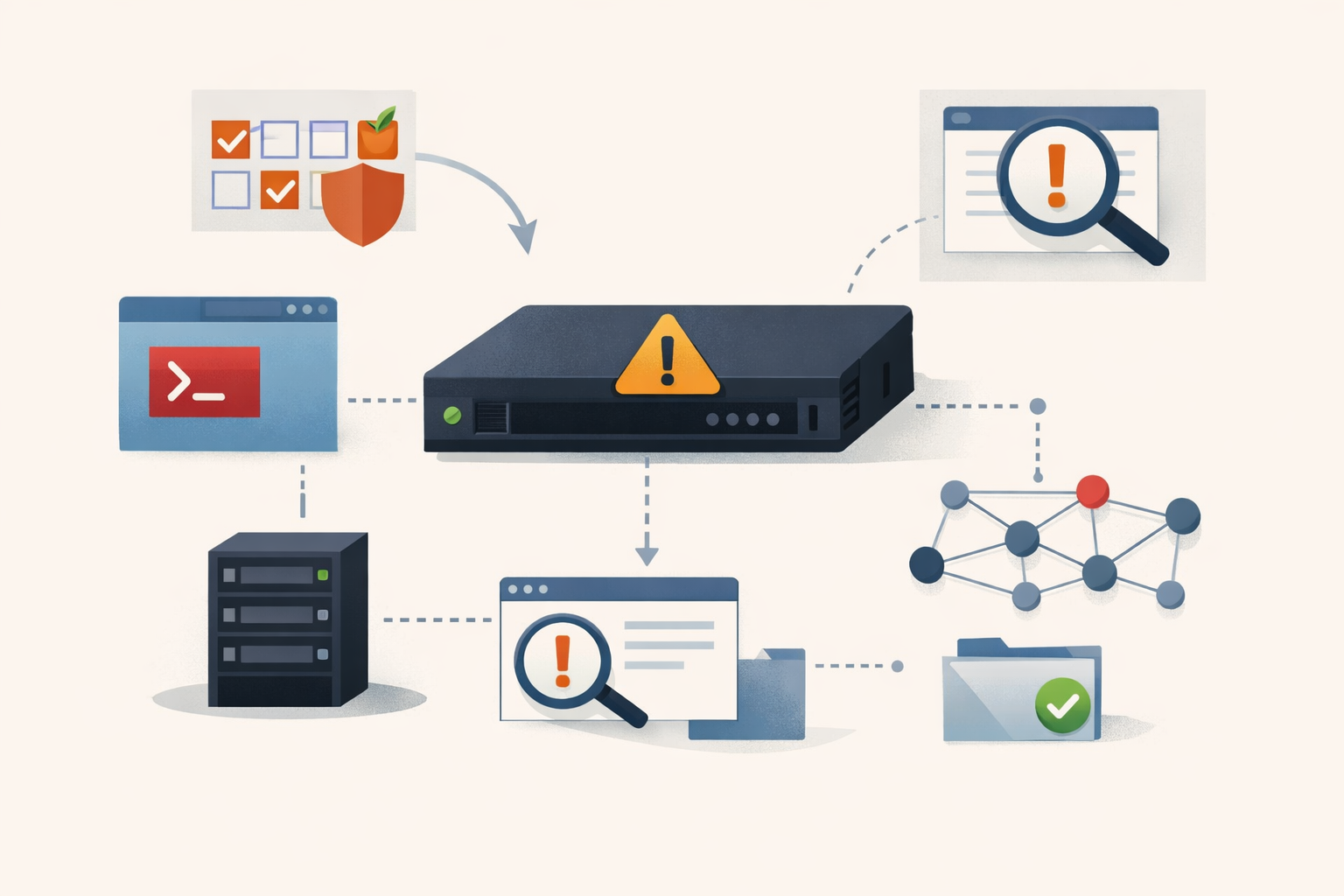
CVE-2023-3519 was a zero-day before it was a patch. By the time Citrix shipped the fix on July 18, 2023, attackers had been using the unauthenticated remote-code-execution flaw on internet-facing NetScaler appliances to drop webshells, and CISA’s advisory documented a critical-infrastructure organization that found one on its ADC. So the question that matters for this CVE isn’t “did you patch.” It’s “is there already a webshell on your NetScaler,” and on a black-box network appliance, that’s a genuinely hard question to answer. Patching closes the door; it does nothing about whoever already walked through it.
This is a runbook for answering the harder question.
What the bug is
CVE-2023-3519 is a code-injection vulnerability (CWE-94) in Citrix NetScaler ADC and NetScaler Gateway, CVSS 9.8, allowing unauthenticated remote code execution. Affected: ADC 12.1 (before 12.1-55.297), 13.0 (before 13.0-91.13), 13.1 (before 13.1-49.13), and the corresponding Gateway builds, per Citrix’s bulletin CTX561482. CISA added it to the Known Exploited Vulnerabilities catalog on July 19, 2023. In the documented intrusion, attackers got root, uploaded a TGZ containing a generic webshell, a discovery script, and a setuid binary, and used the foothold to enumerate Active Directory. Shadowserver later found thousands of compromised appliances and many thousands more still unpatched after the fix shipped.
Step 1 — Patch
- Upgrade NetScaler ADC/Gateway to a fixed build (12.1-55.297+, 13.0-91.13+, 13.1-49.13+, or later). This stops new exploitation. It is necessary and it is not sufficient.
Step 2 — Assume the zero-day window may have caught you, and investigate
Exploitation predated the patch, so a current patch level does not mean you were never compromised. If your NetScaler was internet-facing before you patched, hunt for implants.
- Run the vendor and Mandiant IOC tooling. Citrix and Mandiant published indicator-of-compromise scanners specifically for CVE-2023-3519. Run them against the appliance; they check for the known webshells and artifacts.
- Look for webshells and dropped files. Check for unexpected files in web-served directories on the appliance, recently-created or modified
.php/script files, and the TGZ-delivered artifacts (webshell, discovery script, setuid binary) described in the CISA advisory. - Check shell history and processes. Look for
crontab, unexpected setuid binaries, and shell command history inconsistent with normal administration. Root-level RCE means the attacker could run anything. - Hunt the follow-on, not just the foothold. The documented activity moved from the appliance to Active Directory discovery. Review authentication logs and AD for reconnaissance and lateral movement originating from the NetScaler’s context.
Step 3 — When you can’t be sure, rebuild
This is the part that’s specific to appliances. A NetScaler is a hardened black box; you don’t have the same forensic visibility you’d have on a general-purpose server, and a sufficiently careful attacker can hide an implant where your tooling won’t see it. If the IOC scans are clean but the device was exposed and unpatched during the zero-day window, you’re making a trust decision with incomplete information.
- For a high-assurance result, reset the appliance to a known-good state: reimage/reinstall the firmware fresh rather than trusting a patch-in-place on a possibly-compromised device.
- Rotate everything the appliance held. Session keys, certificates, and any credentials stored on or reachable from the NetScaler. If the device proxies authentication, treat those secrets as exposed.
- If you find evidence of AD discovery or lateral movement, escalate to a full intrusion response. The appliance was the entry; the goal was the network behind it.
Step 4 — Reduce standing exposure
- Restrict the management interface to a management network; it should never be internet-reachable.
- Keep the appliance on a supported, current build, and treat NetScaler patches as out-of-band-eligible given the cadence of critical bugs in this product line.
The lesson
The general point applies to every network appliance: a patch fixes the vulnerability but tells you nothing about what happened during the window it was open, and appliances are exactly the devices where “what happened” is hardest to determine because you can’t inspect them like a server. For a zero-day RCE that drops persistent implants, the responsible posture is patch, hunt with the vendor and Mandiant tooling, and when the appliance was exposed and you can’t prove it’s clean, rebuild rather than trust. CVE-2023-3519 is the canonical case: thousands of organizations patched, and a meaningful fraction of them already had a webshell the patch left untouched. We flag these appliance RCEs the day they land and say plainly that patching is step one of an incident response, not the end of one, when the bug was a zero-day that plants something behind it.
Sources
- CISA Known Exploited Vulnerabilities Catalog
- CISA AA23-201A: Threat actors exploiting Citrix CVE-2023-3519 to implant webshells — 2023-07-20
- NVD CVE-2023-3519 — 2023-07-19
- Citrix security bulletin CTX561482 — 2023-07-18
- Tenable: CVE-2023-3519 critical RCE in NetScaler ADC and Gateway — 2023-07
- Unit 42: Threat brief, RCE vulnerability CVE-2023-3519 on customer-managed Citrix servers — 2023-07
Share
Related field notes
-
CitrixBleed: the patch closed the leak but left the stolen keys working
CVE-2023-4966 leaked post-MFA session tokens from NetScaler. Organizations that patched and stopped there got breached anyway, because a stolen token still worked after the update. The action that mattered was killing every active session, and a lot of victims skipped it.
-
Shitrix: the Citrix bug that taught everyone how fast a perimeter RCE goes from PoC to pandemic
CVE-2019-19781, 'Shitrix,' was a path-traversal RCE in Citrix NetScaler. After disclosure with no patch, a public exploit dropped and mass exploitation followed within days. It set the template for the NetScaler-as-target story that CitrixBleed later continued.
-
They read one file off the VPN gateway and left with your whole Active Directory
CVE-2024-24919 is filed as 'information disclosure.' On a Check Point gateway that meant unauthenticated file read, which meant password hashes, which meant ntds.dit within hours. It was a zero-day for a month before disclosure, and patching it doesn't undo the theft.
One email, every weekday morning.
You're in. Check your inbox.