Microsoft said 'no known exploitation.' The exploit may have been three months old.
When Microsoft patched CVE-2024-26169 in March 2024, the advisory said it wasn't aware of attacks. Symantec later found a Black Basta exploit tool built weeks earlier. The technique it used, an IFEO Debugger key, is one you can detect even when you can't patch in time.
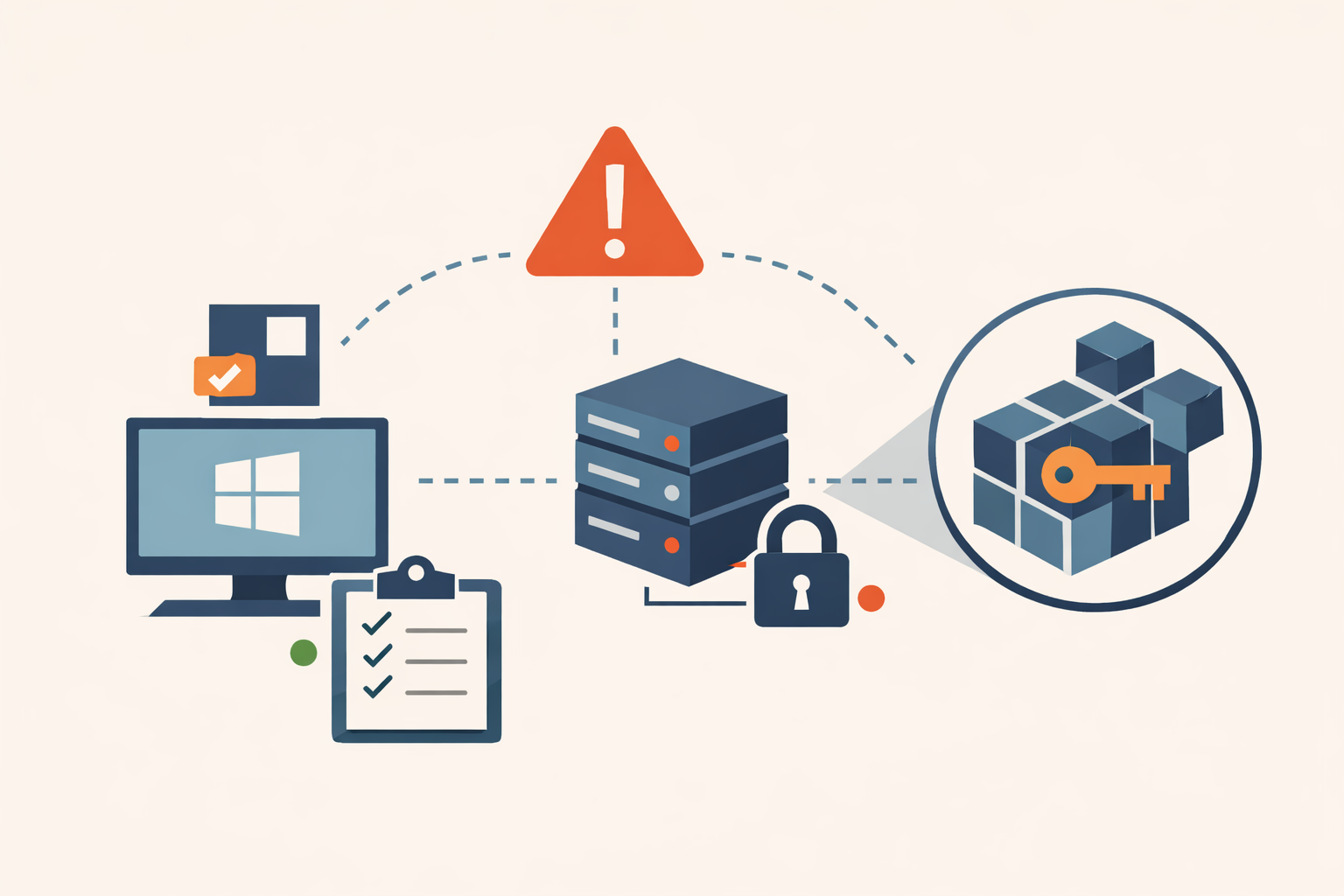
Microsoft patched CVE-2024-26169 on March 12, 2024, and the advisory carried the reassuring boilerplate: not aware of exploitation. Then Symantec’s threat hunters reported finding a Black Basta exploit tool for this exact bug with a compilation timestamp of February 27, 2024, and a second sample stamped December 18, 2023. That’s 14 to 85 days before the fix existed.
The honest caveat first, because it matters: PE compilation timestamps are trivially editable, so they are not proof. Symantec said as much. What they are is a plausible, evidence-backed indication that a major ransomware operation had a working privilege-escalation exploit in hand before the vulnerability was public, while the vendor’s status line read “no known exploitation.” Treat that as the operating assumption it deserves to be, not a certainty, and the conclusion still holds: “we’re not aware of attacks” is a statement about Microsoft’s visibility on patch day, not a guarantee about what’s in a ransomware crew’s toolkit.
What the bug is and how it’s abused
CVE-2024-26169 is an improper-privilege-management flaw (CWE-269) in the Windows Error Reporting Service, CVSS 7.8, local vector. A user-level attacker uses it to become SYSTEM. It affects essentially the whole supported Windows line at the time, Windows 10 from 1507 onward, Windows 11 through 23H2, and Windows Server 2008 through 2022.
The mechanism is worth knowing because it tells you what to watch for. The kernel component werkernel.sys created certain registry keys with a null security descriptor, meaning a low-privileged user could write where they shouldn’t. The exploit used that to set a Debugger value under the Image File Execution Options (IFEO) key for WerFault.exe. IFEO is a legitimate Windows debugging feature: set a Debugger value for a program and Windows launches that “debugger” instead whenever the program runs. Point it at a shell, trigger WerFault.exe, and the shell launches with SYSTEM rights. CISA added the bug to the Known Exploited Vulnerabilities catalog on June 13, 2024, flagged for ransomware use; Black Basta (also tracked as Cardinal, Storm-1811, and UNC4393) and Play have both been tied to it.
The detection that outlives the CVE
Here’s why this one is worth more than a patch ticket. The IFEO Debugger trick is decades old and not specific to CVE-2024-26169. Attackers use it for privilege escalation and for persistence, across many different initial bugs. So while you should absolutely patch this CVE, the durable win is monitoring the technique itself, which catches a whole class of activity regardless of which vulnerability got them the write primitive.
- Alert on creation or modification of
Debuggervalues underHKLM\SOFTWARE\Microsoft\Windows NT\CurrentVersion\Image File Execution Options\*. ADebuggerentry pointingWerFault.exe, or any common system binary, atcmd.exe,powershell.exe, or an unexpected path is high-fidelity malicious. - Watch for
WerFault.exespawning a shell or unusual child process. WerFault is a crash-reporting helper; it has no business launching command interpreters. - Treat any unexpected SYSTEM-context shell whose parent chain runs through Windows Error Reporting as an incident, not noise.
These detections would have fired on this exploit and will fire on the next tool that reaches for the same well-worn technique. That’s a better return than a signature for one CVE.
What to do
- Apply the March 2024 cumulative update across the fleet, workstations included. This is a local privilege-escalation bug, so the machines that matter are the ones where attackers land first, which are usually user endpoints, not just servers. There’s no “doesn’t apply to us” exception given the breadth of affected versions.
- Stand up the IFEO
Debuggermonitoring above if you don’t already have it. It’s cheap, it’s durable, and it pays off well beyond this CVE. - Don’t over-trust “no known exploitation” in vendor advisories for privilege-escalation bugs. That line reflects the vendor’s telemetry at publication. For EoP flaws in particular, exploit tooling circulates inside ransomware operations and isn’t always visible to the vendor, so prioritize EoP patches on their merits rather than discounting them because nobody’s reported attacks yet.
- Patch fast, because the window may already be open. If a capable crew really did hold this for weeks before the fix, then every day an unpatched endpoint sat after March 12 was a day the door was both known and open. You can’t change how long they had it; you can change how long you leave it.
The reframe is about what an advisory’s exploitation status actually tells you. “Not aware of exploitation” is a present-tense report on the defender’s side of the glass. It says nothing reliable about the offense, and for privilege escalation, the offense is frequently ahead. So patch EoP bugs like they’re already in use, and build the detections that catch the technique even when you lose the race to patch. We read the KEV escalation entries with that assumption baked in, because by the time a bug earns its catalog listing, somebody has usually been using it for a while.
Sources
- CISA Known Exploited Vulnerabilities Catalog
- NVD CVE-2024-26169 — 2024-03-12
- Microsoft MSRC: CVE-2024-26169 — 2024-03-12
- SecurityWeek: Ransomware group may have exploited Windows vulnerability as zero-day — 2024-06
- Symantec/Security.com: Black Basta ransomware zero-day — 2024-06
- BleepingComputer: Black Basta ransomware gang linked to Windows zero-day attacks — 2024-06
Share
Related field notes
-
BlueKeep: the wormable RDP bug Microsoft patched Windows XP for
CVE-2019-0708 was a pre-authentication, wormable RCE in Windows Remote Desktop. Microsoft was scared enough of a WannaCry repeat that it shipped patches for end-of-life XP and Server 2003. The worm never fully came, but the lesson did: RDP doesn't belong on the internet.
-
Scattered Spider didn't need a zero-day. They brought a decade-old driver Windows still loads.
CVE-2015-2291 is a vulnerable Intel Ethernet driver. Scattered Spider loaded it to reach the kernel and patch out Defender, CrowdStrike, SentinelOne, and Palo Alto in memory. It's the classic bring-your-own-vulnerable-driver attack, and the defenses are switches you can flip today.
-
Still running SMBv1? The catalog has a 2017 reminder for you.
A cluster of old Windows bugs sits in the KEV catalog: an SMBv1 information-disclosure from the MS17-010 family that powered WannaCry, plus assorted legacy privilege-escalation flaws. They share one fix path: keep supported Windows patched, kill SMBv1, retire end-of-life.
One email, every weekday morning.
You're in. Check your inbox.