A clickable link in a SYSTEM dialog is a SYSTEM shell waiting to happen
CVE-2019-1388 turned a hyperlink in the UAC certificate dialog into a path to NT AUTHORITY\SYSTEM. No exploit code, just clicks: open the cert, click 'Issued by,' and the browser launches as SYSTEM. The lesson is what any interactive element in a privileged process really is.
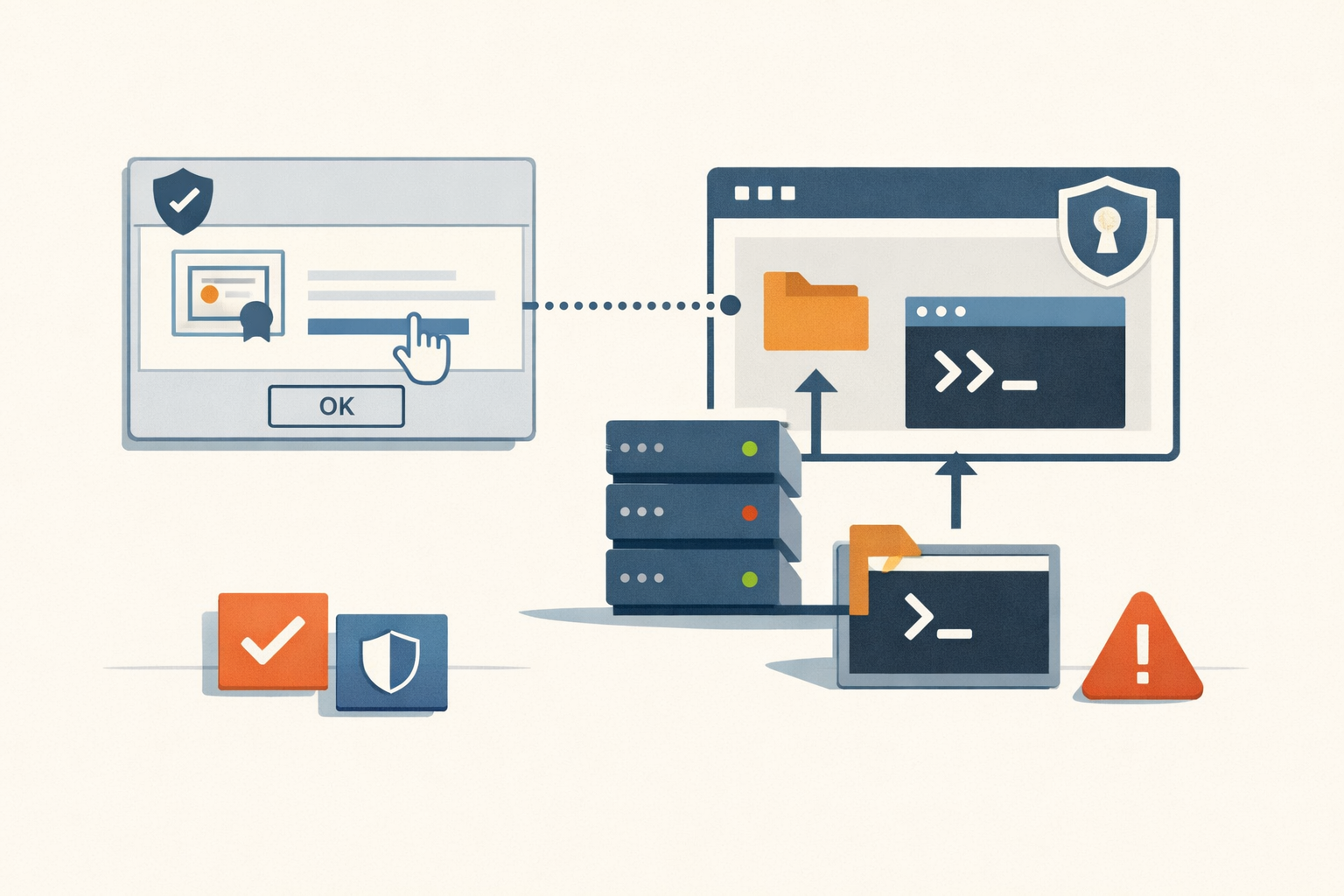
There’s no shellcode in CVE-2019-1388. No memory corruption, no race, no ROP chain. The exploit is a series of mouse clicks, and that’s exactly what makes it worth understanding. The bug lived in the Windows UAC certificate dialog, the one that pops up when you inspect the signature on a program you’re being asked to elevate. That dialog rendered the certificate’s “Issued by” field as a clickable hyperlink, and on the version of the dialog shown by consent.exe during a UAC prompt, Microsoft forgot to disable it. Click the link, and a browser opens, running as NT AUTHORITY\SYSTEM. From a SYSTEM browser, “save as” or “open file location” gets you a file dialog, and from a file dialog you can launch a command prompt. SYSTEM shell, by clicking.
What the bug is
CVE-2019-1388 is a privilege-escalation flaw (CWE-269) in the Windows Certificate Dialog, CVSS 7.8, affecting older Windows 7, 8, 10, and Server builds before the November 2019 fix. Microsoft’s advisory covers it, and CISA added it to the Known Exploited Vulnerabilities catalog on April 7, 2023, with the ransomware flag. The repro is almost comically simple: take any Microsoft-signed executable (an old Windows hardware-installer binary was the classic choice), try to run it as administrator so UAC prompts you, click “Show more details,” then “Show information about the publisher’s certificate,” and click the hyperlinked “Issued by” entry on the certificate’s General tab. The hyperlink opens Internet Explorer as SYSTEM because the dialog inherited the elevated context of the consent process, and IE never dropped it. Then it’s a short walk through the browser’s file dialogs to a SYSTEM command prompt.
Because there’s no binary to write or exploit to compile, this became a staple of penetration-testing labs and a reliable local-privilege-escalation move on any unpatched machine, which is the kind of bug that lingers for years on the systems nobody updates.
The lesson: privileged UI is attack surface
The interesting thing here isn’t the certificate dialog specifically; it’s the category. Any interactive element rendered by a process running with high privileges is a potential escape hatch, because every affordance the UI offers, every clickable link, every “browse” button, every embedded file picker, runs in that privileged context unless someone deliberately locks it down. A hyperlink that opens a browser is harmless in a normal application. The same hyperlink in a dialog running as SYSTEM is a way to spawn an arbitrary SYSTEM process.
That generalizes to a design principle worth applying well beyond this CVE:
- High-privilege processes should expose as little interactive surface as possible. Every link, dialog, and “open with” handler in a SYSTEM-context UI is a way out unless explicitly disabled. The fix for CVE-2019-1388 was, fittingly, just disabling the hyperlink, which is to say the safe behavior was always available; it was the default that was wrong.
- Elevation prompts are themselves attack surface. UAC is a security boundary, and the consent UI runs privileged. Anything it renders, including data attacker-influenced like a certificate’s fields, is a place to look for an escape.
- “It needs local access” is not a reason to deprioritize. Like every elevation bug, this requires a foothold first. And like every elevation bug, that’s precisely the step an intruder reaches for after phishing their way onto a workstation. A clicks-only LPE that anyone can perform is a gift to that intruder.
What to do
- Patch. The November 2019 update fixes it by enforcing privileges in the certificate dialog. Any system patched anytime in the last several years is covered; the risk is entirely in the unpatched and legacy population, which is also where this bug is most useful to an attacker.
- Find and remediate legacy and end-of-life Windows. This bug’s natural habitat is machines that stopped getting updates: old Windows 7 and Server 2008 boxes, kiosk and OT systems, the workstation in the corner running something that “can’t be touched.” Inventory them; they’re the ones still exposed.
- Don’t lean on UAC as a strong boundary on unpatched systems. UAC is useful, but it has a long history of bypasses, and this is one of the cleanest. On systems you can’t patch, assume local elevation is achievable and compensate with stricter application control and tighter limits on who gets a local foothold at all.
- Watch for the tell. A browser or command prompt spawning from
consent.exe, or a SYSTEM-context process launched from a UI interaction, is anomalous and worth alerting on.
The reframe is short and broadly applicable. When you put a UI in front of a privileged process, you’ve turned every interactive element into a potential privilege grant, and the defaults will betray you unless someone checks. CVE-2019-1388 is the purest example: no exploit, just a link nobody disabled, leading straight to SYSTEM. The bugs that require no code are easy to dismiss as unserious, but a privilege escalation anyone can perform with a mouse is exactly the kind an attacker loves. We track even the old, clicks-only entries, because they live longest on the machines least likely to be patched.
Sources
- CISA Known Exploited Vulnerabilities Catalog
- NVD CVE-2019-1388 — 2019-11-12
- Microsoft MSRC: CVE-2019-1388 Windows Certificate Dialog Elevation of Privilege — 2019-11-12
- VK9 Security: CVE-2019-1388 Microsoft Windows Certificate Dialog privilege escalation — 2019
- Threatpost: High-severity Windows UAC flaw enables privilege escalation — 2019-11
Share
Related field notes
-
Two years of Patch Tuesdays, one message: the exploited Windows bug is almost always a privilege escalation
Across 2025 and 2026, Microsoft kept fixing already-exploited Windows flaws, storage drivers, Hyper-V, the network stack, even a 20-year-old third-party modem driver. They don't each need their own post. Together they make one point about patching Windows fast.
-
The FBI dismantled QakBot in 2023. In 2024 it was test-driving a Windows zero-day.
CVE-2024-30051 is a DWM Core Library privilege escalation to SYSTEM, used as a zero-day. Kaspersky tied it to QakBot, the botnet taken down nine months earlier, and found the exploit was already in several groups' hands before the patch.
-
The boring privilege-escalation bug is the one that finishes the job
CVE-2024-30088 is a local Windows kernel race condition. It needs an attacker who's already inside, which is exactly why it gets deprioritized. APT34 used it to turn a foothold into SYSTEM, then dropped a password filter to skim every cleartext login.
One email, every weekday morning.
You're in. Check your inbox.