Why most patch summaries fail the people who actually have to do the work
Vendor advisories are written for completeness. They're not written for the operator triaging a CISA KEV ticket before lunch.
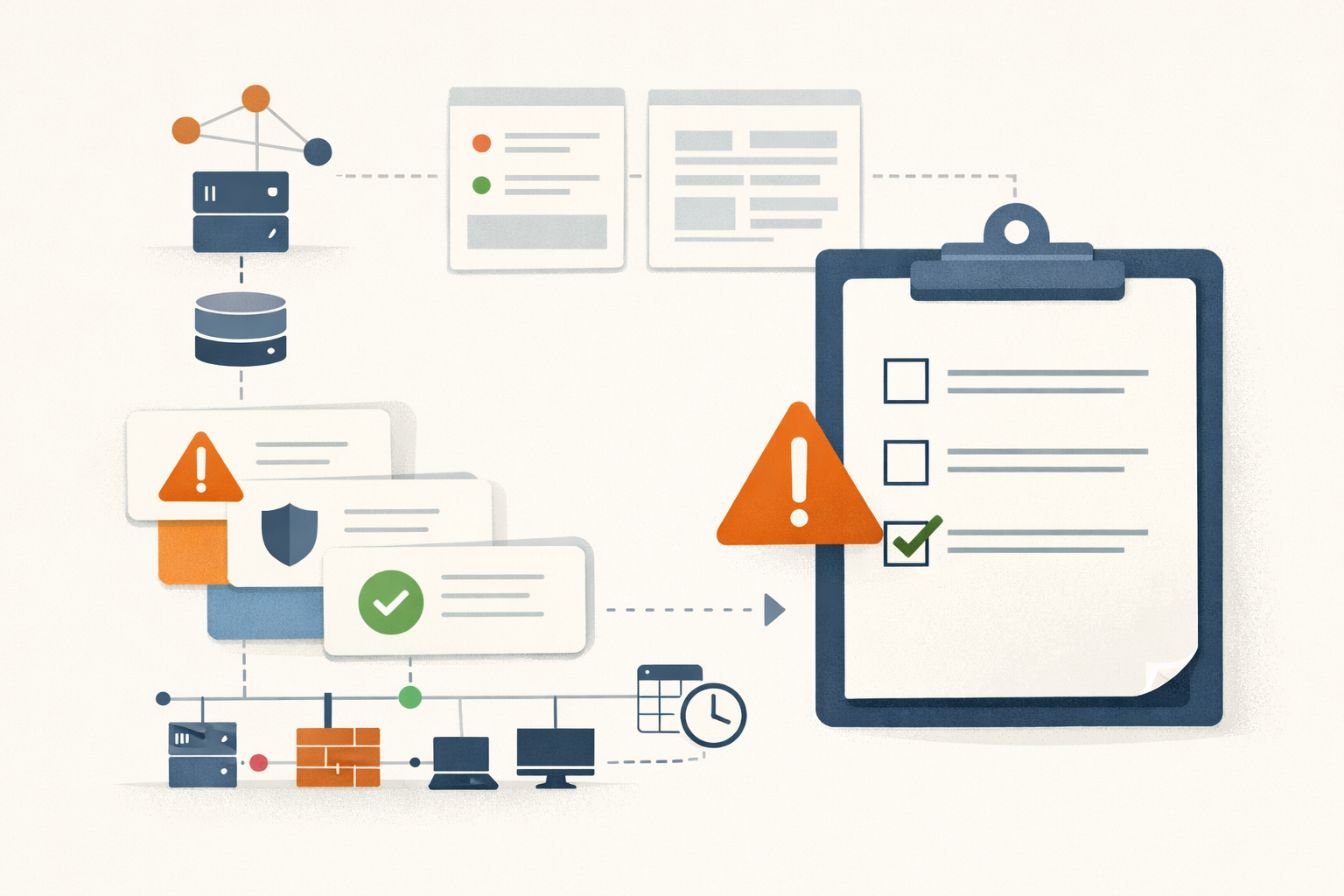
A CISA KEV ticket lands in your queue at 9:14 AM. Three CVE IDs, no context beyond the security team’s forward. Your first click is NVD. What you find there is a legally complete writeup that answers every question a compliance auditor could ask and none of the ones running through your head right now.
You want to know if this thing is being exploited today. You want to know if it hits the versions you actually run. You want to know if you can wait until Thursday’s maintenance window or if you need to start rescheduling meetings. NVD gives you a CVSS vector string, a CWE classification, and six paragraphs about affected configurations that read like someone pasted a database query into a sentence.
That’s not a failure of NVD. That’s NVD doing exactly what it’s supposed to do.
The completeness trap
Vendor advisories have to cover every product, every version, every configuration. Microsoft’s monthly Security Update Guide routinely lists 100+ CVEs, each one tagged with the full matrix of affected builds. Adobe’s bulletins spell out every Creative Cloud component down to the point release. Google’s Chrome release notes reference internal bug tracker IDs that nobody outside the Chromium team can read.
This is the right shape for a SOC analyst building detection rules. It’s the right shape for a compliance officer checking boxes. It’s the wrong shape for the person who has four hours of real sysadmin work to do and just got handed three new tickets that say “patch this.”
The completeness is the problem. When every possible detail is included, the operator has to do the filtering themselves. And filtering takes time that most IT teams don’t have budgeted into a Tuesday morning.
What goes missing
The advisory answered the legal question: “Is this vendor liable if the customer doesn’t patch?” What it didn’t answer is the set of questions that actually drive your next action:
Is this being exploited right now, or is it theoretical? CVSS doesn’t tell you. A 9.8 with no known exploit and a 7.5 on CISA’s Known Exploited Vulnerabilities list are wildly different situations, but the advisory treats the 9.8 as the bigger deal.
Which versions in my environment does this actually hit? The CPE strings in the advisory cover every version ever shipped. You run three of them. The advisory doesn’t know that, and it won’t highlight the ones that matter to you.
What’s the user-facing blast radius if I don’t patch in the next 24 hours? The advisory describes the technical impact (remote code execution, privilege escalation, information disclosure). It doesn’t translate that into “your print services will go down” or “an attacker on your VPN can read any mailbox.”
Can this wait until Thursday’s maintenance window? No advisory will ever say “yes, this can wait.” Liability runs one direction. But some patches genuinely can wait, and knowing which ones is the difference between a planned rollout and an emergency change window that disrupts your users.
Is this one of the 5% that needs to wake someone up? Most CVEs don’t. The ones that do share a few traits: active exploitation, internet-facing attack surface, credential-adjacent impact. The advisory doesn’t sort by that. You have to.
The five fields operators actually want
After years of triaging these tickets, the real decision comes down to five things. Everything else is context you can look up later if you need it.
Exploit status. Is this being actively exploited in the wild, or is the proof of concept sitting in a GitHub repo that three people have starred? CISA KEV is the fastest public signal here. If the CVE is on KEV, the timeline compresses to days, not weeks.
Affected platforms in practice. Not the full CPE matrix. The three-word version: does this hit Windows Server, does this hit Chrome, does this hit your VPN appliance. If you don’t run the affected product, the ticket closes itself.
User-facing risk. What actually breaks or gets exposed if this goes unpatched? “Remote code execution” means different things when the target is an internet-facing web server versus an internal print spooler that five people use. The operator needs the translated version.
Can-it-wait window. How long can you reasonably defer this without the risk profile changing? A CVE with active exploitation and internet-facing exposure: today. A high-severity local privilege escalation with no public exploit: Thursday’s window is fine. The advisory never says this. Someone has to.
Escalation trigger. What would change this from “Thursday” to “right now”? Usually it’s one of three things: a public exploit drops, CISA adds it to KEV, or your threat intel feed flags a campaign targeting your sector. Knowing the trigger lets you close the ticket for now and reopen it if conditions change.
Why nobody writes it this way
The people who write security advisories don’t operate the servers. They’re researchers, analysts, or vendor security teams. Their job is accuracy and completeness, and they’re good at it. Asking them to also write the operator’s triage summary is asking them to do a job they’ve never done.
The people who operate the servers don’t have time to write. They’re the ones reading the advisory at 9:14 AM, trying to figure out if they need to cancel their 10 o’clock. By the time they’ve triaged the ticket, the knowledge lives in their head and maybe a Slack thread that nobody will find next month.
That gap between “here’s every technical detail” and “here’s what you actually need to do about it” is the entire reason PatchDayAlert exists. Not because the advisories are bad. Because they’re written for a different audience, and the operator audience doesn’t have a version written for them.
The ticket that lands tomorrow
This site doesn’t solve the problem everywhere. It solves it for the CISA KEV ticket that’s going to land in your queue tomorrow morning, and the one after that, and the one on Patch Tuesday that comes with 15 friends.
The digest handles the daily triage. The blog exists because the rest of the job, the part that isn’t just “which CVE do I patch first,” is also worth writing about. The frameworks, the tools, the six different patch surfaces that all need attention every week. That’s where the longer posts come in.
If you’re the person who got handed the patch list, this is written for you.
Sources
Share
Related field notes
-
The patch triage meeting that ends with owners, not opinions
The short-list is built before anyone sits down. The meeting exists to put a name and a clock on each item, then end. Here's how to run it in fifteen minutes.
-
A 30-minute Patch Tuesday triage you can actually run
How to get from 150 CVEs to the 4-8 that change your week, using only public signals and a clock.
-
Does this CVE actually apply to you? Three filters before you patch
Single-score triage fails in both directions: 10.0s that don't apply, 4.3s that get exploited for 13 days. Three filters reduce the queue.
-
A 4.3 that mattered: the 13-day gap between patch and exploitation flag
Microsoft patched CVE-2026-32202 on April 14 without marking it exploited. APT28 had been using it since at least December. The gap between those two facts is where triage models break.
Get the free CVE triage cheat sheet
Subscribe and we'll email you the one-page triage flow for fresh CVEs. Plus the weekly digest.
Subscribe