People problems wearing a server badge
The sysadmin job was sold as infrastructure. The actual job is diplomacy, and the burnout numbers show it.
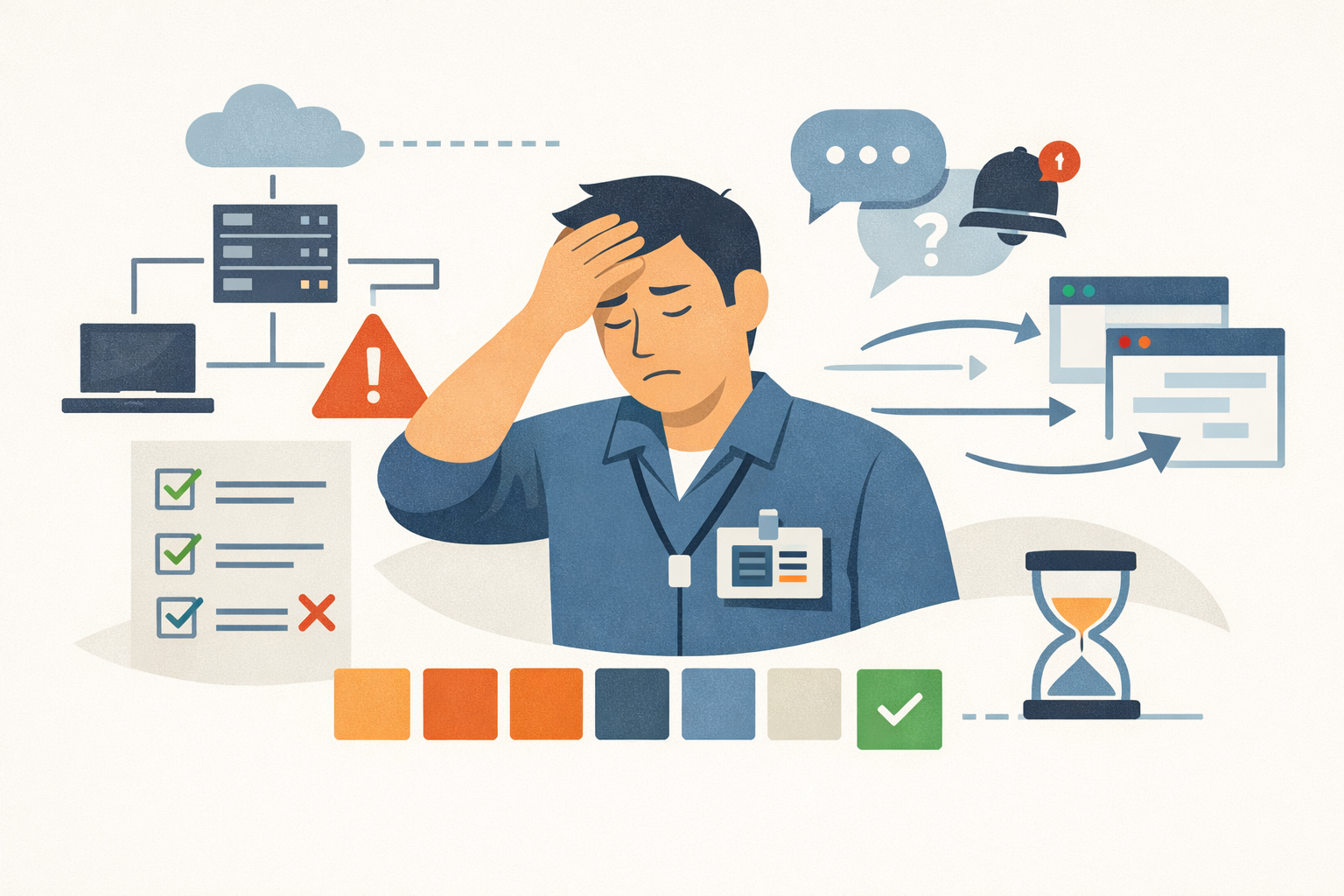
The most-upvoted career advice on r/sysadmin is not about DNS, Active Directory, or backup retention. It is “Go home on time and take care of your loved ones.” Nine hundred sixty-nine upvotes. The second-most-upvoted is “Shut the f*** up.” Four hundred thirty-two upvotes. The community that lives inside server rooms has concluded, by popular vote, that the job is an emotional-regulation problem.
They are correct. And nothing in the job description prepared them for it.
The time audit nobody wants to see
Microsoft’s 2023 Work Trend Index surveyed 31,000 workers and layered in telemetry data. Fifty-seven percent of the average knowledge worker’s day goes to communication, against 43 percent creating. Workers toggle between applications 1,200 or more times per day. Gloria Mark’s peer-reviewed research at UC Irvine found that it takes 23 minutes and 15 seconds to recover from an interruption, and workers are interrupted every three to four minutes. Asana’s Anatomy of Work study, with nearly 10,000 respondents, found that 58% of time goes to “work about work,” their term for the coordination overhead that is not the work itself.
None of this is sysadmin-specific. All of it is sysadmin-concentrated. The sysadmin sits at the intersection of every team that uses technology, which is every team. They have no authority over any of those teams. Red Hat’s own documentation acknowledges this: “Many sysadmins work with different teams and customers but have no authority over them.” The role is all responsibility and no leverage, which means the only tool available is persuasion. Persuasion is a people skill. The hiring pipeline selects for people who are good at troubleshooting packet captures.
Three archetypes that look like tickets
Every sysadmin recognizes these. They arrive as tickets or emails or Slack messages. They are not technical problems.
The executive who won’t patch. A CHI 2024 study found that 18% of sysadmins report executive override on patching decisions. The conversation is never “I understand the risk and accept it.” The conversation is “not now” repeated until the vulnerability is either exploited or forgotten. The sysadmin’s job, supposedly, is to apply patches. The actual job is to build enough trust with a senior leader that they stop overriding the process. That is relationship management. It does not appear in any certification exam.
The shadow IT builder. A department gets tired of waiting eight weeks for a SharePoint site and stands up their own solution. The frustration is legitimate. The execution is a security problem. The fix is not a firewall rule. The fix is a provisioning process fast enough that people stop routing around it, combined with enough empathy to understand why they did. That is organizational design work performed by someone whose title says “systems administrator.”
The blame redirector. The Lone Sysadmin blog put it plainly: “Operations staff are like janitors; clean buildings are assumed natural. Miss a spot and blame rolls in.” When something breaks, the sysadmin is the first person contacted and the last person credited when it was working. The skill required here is not incident response. It is the ability to document your work visibly enough that the organization understands what “working” costs, without sounding defensive. That is a communication problem with career consequences.
The gap the industry built
ISACA’s 2024 State of Cybersecurity report surveyed more than 1,800 professionals. The number-one skills gap, at 58%, was communication. Not cloud architecture. Not zero trust. Not AI. Communication. By 2025, the number climbed to 59%. CompTIA found that 41% of organizations planned a new emphasis on communication skills. The TestGorilla/NSSA 2023 survey of recruiters found that 89% say bad hires fail due to soft skill gaps, not technical ability.
The industry has known this for years. The training pipeline has not adjusted. The certification ecosystem teaches you how to configure a VLAN, not how to explain to a CFO why the VLAN matters. The job interview asks you to whiteboard a network topology, not to describe how you convinced a resistant team to adopt MFA. The entire professional development structure is optimized for a version of the job that represents, generously, 40% of the actual work.
The cost of pretending otherwise
The 2024 State of DevOps report found that 67% of IT professionals experience burnout. Help desk roles, the entry point for most sysadmin careers, have a turnover rate of 40.6% with an average tenure of 2.5 years, according to HDI. Gallup found that 42% of turnover is preventable, and 70% of preventable leavers cite management-behavior changes as the thing that would have kept them.
A peer-reviewed study in the ACM SIGMIS Database (2011) found that surface acting, the clinical term for faking calm while dealing with frustrated users, is a strong predictor of IT worker exhaustion. That was fifteen years ago. Nothing changed. ISACA’s own 2024 report identified “dropping levels of management support, poor communication, and empathy” as burnout accelerators.
The PDQ State of Sysadmin 2025 survey, with 1,600 respondents, found that 56% of sysadmins believe extraterrestrials exist. The most common follow-up: “Most say their end users are proof.” That is a joke, but it is also a tell. When the coping mechanism for your job is alien humor about the people you serve, the relationship between operator and organization has broken down.
What realistic looks like
The coordination load is structural. The interpersonal friction is inherent to a function that touches every department without owning any of them. Pretending the job is about servers and hoping the people part sorts itself out has produced a 67% burnout rate and a turnover cycle measured in months.
Realistic expectations mean acknowledging that a sysadmin who can explain a risk to a non-technical executive is more valuable than one who can recite RFC numbers. It means hiring for communication tolerance, not just technical depth. It means building feedback loops where ops teams can surface what they are actually spending time on, so that leadership stops being surprised when the infrastructure person says the job is mostly meetings and negotiations.
PatchDayAlert handles the triage so your persuasion budget goes to conversations that need a human in the room.
The third-most-upvoted advice on r/sysadmin, at 108 votes: “If you enjoy receiving thanks and accolades you are in the wrong line of work.” The community has diagnosed the problem. The industry has not yet decided to treat it.
Editor’s note (2026-08-22): An earlier version rounded the Work Trend Index figure to sixty percent. The cited page says 57 percent communicating and 43 percent creating. Corrected after an accuracy review.
Sources
- Microsoft 2023 Work Trend Index Annual Report
- The Cost of Interrupted Work: More Speed and Stress (Gloria Mark, UC Irvine)
- Anatomy of Work Global Index 2022 (Asana)
- What Is a Sysadmin? (Red Hat)
- Not as Easy as Just Update: Survey of System Administrators and Patching Behaviours (CHI 2024)
- The Lone Sysadmin (Bob Plankers)
- State of Cybersecurity 2024 (ISACA)
- IT Industry Outlook 2024 (CompTIA)
- The State of Skills-Based Hiring 2023 (TestGorilla)
- 2024 Accelerate State of DevOps Report (DORA / Google Cloud)
- Metric of the Month: Annual Agent Turnover (HDI)
- 42% of Employee Turnover Is Preventable but Often Ignored (Gallup)
- Work Exhaustion in IT Professionals: The Impact of Emotion Labor (ACM SIGMIS Database, 2011)
- The State of Sysadmin 2025 (PDQ)
Share
Related field notes
-
The security work that landed on ops
Cloud shared responsibility, compliance mandates, and insecure defaults have quietly moved security execution onto ops teams that were never staffed for it.
-
Your security vendor's AI isn't making you safer. It's making you tired.
76% of cybersecurity professionals say the AI landscape is overwhelmed by overpromotion. The operational cost of that fatigue is starting to show up in the places that matter.
Get the free CVE triage cheat sheet
Subscribe and we'll email you the one-page triage flow for fresh CVEs. Plus the weekly digest.
Subscribe