Best practices for patch prioritization in a hybrid environment: start with business impact
Severity scores tell you which CVE is nastiest. Business impact tells you which one matters.
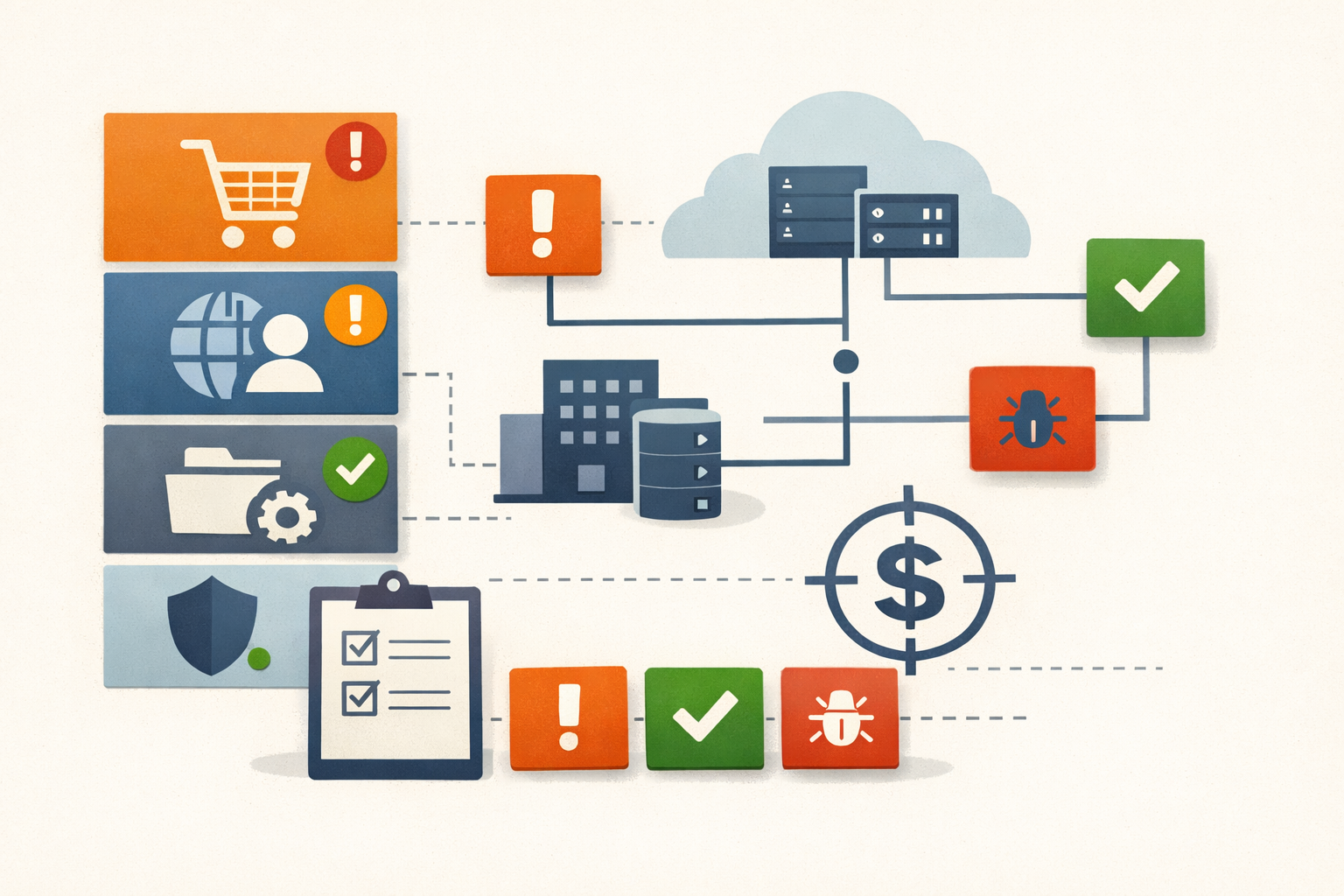
A Tuesday morning queue: a critical remote code execution flaw on a developer sandbox nobody’s touched in eighteen months, an authenticated privilege escalation on the e-commerce platform that processes twelve thousand orders a day, and three actively-exploited identity bugs spread across two cloud tenants and one on-prem domain controller. Vendor severity ratings tell you which one is technically nastiest. They don’t tell you which one matters. In a hybrid environment, the gap between technical risk and business impact is where prioritization actually happens, and most patching guidance never crosses that gap.
Categorize systems by business function
The first move is mapping systems to what the business actually cares about, not to how the network diagram is drawn.
Group your assets into four categories: revenue-generating (anything that directly produces income — e-commerce, billing, transaction processing), customer-facing (the marketing site, support portals, public APIs), internal productivity (file shares, collaboration tools, internal apps), and compliance/regulatory (anything bound by HIPAA, PCI, SOX, or contractual SLAs).
Not every “critical” system carries the same weight. A four-hour outage on the payroll system that runs once every two weeks is an inconvenience. A four-hour outage on the marketing site during a product launch is a different conversation. A four-hour outage on the payment gateway during business hours is a meeting with the CEO.
Work with department leaders to map this. Don’t guess. The CRM the sales team lives in might be invisible from the network diagram but worth more revenue than half the production servers. The internal file share that hosts contract templates probably isn’t. A dev sandbox is almost never worth the same urgency as a customer-facing system, no matter how loud the advisory.
Measure business impact in practical terms
Categorization gets you the buckets. Scoring gets you the order within them.
Define impact along four dimensions: downtime cost (revenue lost per hour of outage), customer impact (do customers see it, do they leave, do they call), operational disruption (how many internal processes stop), and regulatory exposure (breach notification triggers, audit findings, SLA penalties).
Use a simple 1–5 scale per dimension. You’re not building a finance model. You’re building a tiebreaker for the Tuesday morning triage call. Speed matters more than precision. A 5/4/3/2 score on a system is good enough to make a decision; a spreadsheet that takes two days to calculate is not.
Run the scores once, then revisit them quarterly or after major architecture changes. They drift, but they don’t drift fast.
The output you want: when a CVE lands, you can pull the affected system’s score in ten seconds. A vulnerability on a public-facing app with active exploitation and a 5/5 customer-impact score outranks a higher-severity issue on a 1/1 internal tool every time. The advisory describes the bug in a vacuum. Your score describes what’s at stake.
Layer technical severity onto business context
Now the inputs come together.
For each CVE, you already have the technical signals: how the bug behaves, whether there’s a working exploit, what the threat intel feeds say, and whether it’s on CISA’s Known Exploited Vulnerabilities list. From the previous step, you have the business signals: which systems are affected and what their impact score is. Stack them in a simple matrix:
- High severity + high business impact: immediate action. Cancel the meeting.
- High severity + low business impact: scheduled. Goes into the next maintenance window.
- Low severity + high business impact: evaluate quickly. Most of the time it can wait, but sometimes a “medium” CVE on critical infrastructure is the one that ruins your week.
- Low severity + low business impact: track and batch. Don’t burn cycles on these out of cycle.
The common failure mode is treating the matrix as one-dimensional. Teams chase the loudest “critical” alerts on dev sandboxes while a quieter authenticated bypass sits unpatched on the customer-facing API for three weeks. The dramatic-looking advisory wins the dashboard. The unflashy one writes the incident report.
Severity tells you how bad a successful attack would be in theory. Business context tells you whether anyone gets paid the next morning.
Align patch windows with business operations
Priority gets you the order. Timing gets you the trust.
Patching the right thing in the wrong window is how IT teams burn credibility. The retail team doesn’t care that you saved them from CVE-2026-XXXX if you took the order system down at 11 AM on Black Friday. Work with each business unit to define maintenance windows that actually fit their operations: when they’re idle, when they can absorb a five-minute glitch, when a reboot won’t cost anyone money.
Hybrid environments make this harder. The cloud SaaS the finance team uses follows the vendor’s window. The on-prem ERP follows yours. Global teams mean there’s no universal “off hours.” Map the constraints once, document them, and patch within them.
Predictable beats fast. A standing second-Wednesday window that nobody dreads is worth more than ad hoc patches that interrupt three different teams.
Share the decisions, don’t just execute them
When a Patch Tuesday list shifts a non-critical update to next month so the customer-facing patch can ship this week, tell the stakeholders affected. Be explicit about the trade-off: “We’re delaying the file-server reboot to prioritize the gateway fix because active exploitation is in the wild and the gateway is internet-facing.” Three sentences, sent before the change, beats an apology email after.
Build a feedback loop. Department leads should be able to tell you when a window doesn’t work, and you should be able to tell them when their request can’t be honored. A short monthly note summarizing what was patched, what was deferred, and why turns prioritization into a process the business trusts. That trust is what reduces escalations and reactive firefighting later.
Prioritization is a business decision
Patch prioritization is not a technical exercise. It’s a business decision dressed up in technical inputs.
Teams that integrate business context make better trade-offs. They don’t waste maintenance windows on low-impact systems. They don’t lose stakeholder trust by patching the wrong thing at the wrong time. They focus effort where it actually matters, which in a hybrid environment is the only way to keep up.
The CVE feed will never stop. The cap on what your team can patch this week will never go up. The lever you control is choosing well, and choosing well starts with knowing what’s worth choosing for.
Sources
Share
Related field notes
-
Patch now, patch later, ignore for now: the triage model real IT teams actually need
A three-bucket triage model for sysadmins who don't own a vulnerability scanner and aren't going to buy one.
-
The patch queue is being rebuilt around the asset, not the score
In the same month, CISA and Microsoft both demoted CVSS as the thing that decides what to patch first. The order of operations is inverting: asset context is becoming the queue.
-
Does this CVE actually apply to you? Three filters before you patch
Single-score triage fails in both directions: 10.0s that don't apply, 4.3s that get exploited for 13 days. Three filters reduce the queue.
-
Microsoft April 2026 Patch Tuesday: the CVE count is the wrong unit
Roughly 160+ CVEs landed in April. About six of them change what an IT team does this week.
Get the free CVE triage cheat sheet
Subscribe and we'll email you the one-page triage flow for fresh CVEs. Plus the weekly digest.
Subscribe