The Linux firewall bug your users can reach because you gave them a private root
CVE-2024-1086 is an nf_tables use-after-free that hands a local user root. The reason an unprivileged user can touch the kernel's packet-filtering engine at all is unprivileged user namespaces, and turning those off defuses a whole class of these bugs at once.
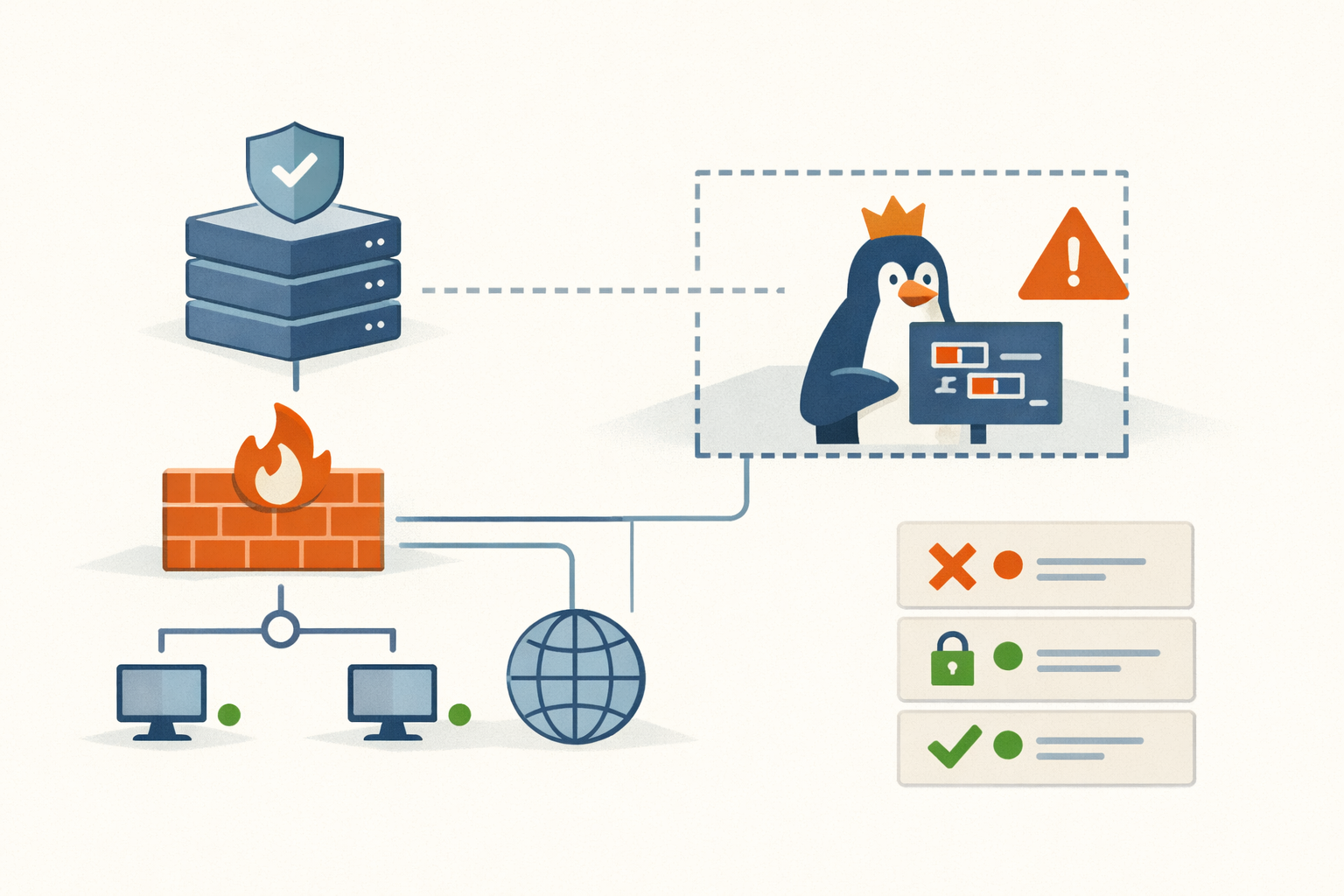
An unprivileged Linux user has no business reaching into nf_tables, the kernel’s packet-filtering engine. Configuring the firewall is a root job. And yet CVE-2024-1086, a use-after-free in exactly that subsystem, is exploitable by a normal local user on a default install of many popular distributions. The reason is a feature most admins never think about: unprivileged user namespaces. They let an ordinary process create a namespace in which it holds root-like capabilities, including the ability to manage network filtering inside that namespace, which puts the nf_tables code path within reach of someone who has no real privileges at all. The bug is the vulnerability. User namespaces are the door.
What the bug is
CVE-2024-1086 is a use-after-free (CWE-416), more precisely a double-free, in the kernel’s netfilter nf_tables component, CVSS 7.8. The nft_verdict_init() function accepts positive values as a drop error in a hook verdict, and nf_hook_slow() can then double-free when an NF_DROP is issued with a drop error that looks like NF_ACCEPT. Exploited, it gives local privilege escalation to root. The affected range is wide, covering kernels from 3.15 up through the 6.7 series and a 6.8 release candidate, which is to say most kernels that were in production when it landed. The upstream fix was committed and the bug was published January 31, 2024.
What turned this from a serious bug into a commodity one was reliability. In March 2024 a researcher using the handle Notselwyn published a detailed writeup and proof-of-concept demonstrating a highly reliable exploit across kernels 5.14 through 6.6, using a technique for manipulating page allocations. A reliable public LPE is a different threat than a fragile one: it gets folded into toolkits, used by operators who didn’t develop it, and run at scale. CISA added the bug to the Known Exploited Vulnerabilities catalog on May 30, 2024, with the ransomware-use flag, and through 2025 it was reported in active ransomware campaigns as Linux-targeting groups leaned on it for the escalation step.
The pattern under the bug
CVE-2024-1086 is not the first serious kernel vulnerability reachable through unprivileged user namespaces, and it won’t be the last. The same feature has been the enabling primitive for a long line of nf_tables and other kernel LPEs. The reason is structural: user namespaces dramatically expand the kernel attack surface available to unprivileged code. Subsystems that were implicitly protected by “you need to be root to get here” become reachable by anyone the moment a normal user can spin up a namespace where they’re root, even if that root is supposed to be confined.
That makes unprivileged user namespaces one of the highest-leverage hardening decisions on a Linux fleet, because the control isn’t bug-specific. Disabling them doesn’t just close CVE-2024-1086; it closes the access path for an entire category of kernel escalation bugs that depend on the same primitive, including ones not yet discovered. Very few mitigations work prospectively against unknown vulnerabilities. This one does, for a meaningful class of them.
The catch, and the reason this is a judgment call rather than a blanket recommendation, is that unprivileged user namespaces are load-bearing for some legitimate software. Container runtimes in rootless mode, certain sandboxes (including some browser sandboxes), and various developer tools rely on them. Turn them off on a host running rootless Podman or a tool that sandboxes with user namespaces and you’ll break it. So this is a control to apply deliberately, per workload, not a switch to flip everywhere.
What to do
- Patch the kernel. The real fix is in the kernel update past the patch commit; on enterprise distros, install the vendor’s fixed kernel for CVE-2024-1086 and reboot into it. A patched kernel that hasn’t been booted is not protecting you, which on Linux is an easy gap to miss because installing a kernel doesn’t activate it.
- Decide on unprivileged user namespaces deliberately. On servers that don’t run rootless containers or namespace-based sandboxes, disabling unprivileged user namespaces is strong defense in depth. On Debian and Ubuntu,
sysctl kernel.unprivileged_userns_clone=0; more broadly,sysctl user.max_user_namespaces=0removes the capability. Test against your workloads first, because the failure mode is “the sandboxed app silently stops working.” - Or blacklist
nf_tableswhere it isn’t needed. If a host doesn’t use nftables for its firewalling, preventing the module from loading removes this specific attack surface. Confirm your firewall tooling first. - Detect the escalation, not just the entry. A reliable LPE leaves traces: unexpected processes gaining root, namespace creation by accounts that have no reason to, and the post-exploitation that follows. EDR and audit rules that flag a non-root process suddenly operating with root privileges catch this class regardless of which kernel bug got them there.
The reframe worth carrying into your hardening standard: most of your patch effort is reactive, one fix per disclosed bug, always a step behind. Unprivileged user namespaces are a rare chance to be proactive, because so many kernel escalation bugs route through them that constraining the feature shrinks your exposure to vulnerabilities that haven’t been published yet. Patch CVE-2024-1086 because it’s actively exploited, and while you’re there, decide whether your servers actually need to hand every user a private root. We track the KEV kernel-escalation entries with that lens, because the durable wins are the controls that close a category, not the patches that close one bug.
Sources
Share
Related field notes
-
Copy Fail is a 732-byte root shell. Patch your Linux fleet this week.
CVE-2026-31431 is a deterministic privilege escalation in the Linux kernel affecting versions 4.14 through 6.19. A Python script gives any local user root. Every major distro is affected, containers don't help, and the mitigation is trivial.
-
Commvault CVE-2025-34028: upgrading to 11.38.20 is not the whole fix
CVE-2025-34028 gives pre-auth RCE on Commvault Command Center. The patch landed in April and the federal deadline passed in May, but the fix requires supplemental update packages beyond the base version, and most shops check the version number and stop there.
-
Jenkins CVE-2024-23897: from 'limited file read' to your secret key
The KEV entry calls it 'limited read access to certain files.' On a Jenkins controller, the files include the cryptographic key that turns read into remote code execution. Here's how to check, patch, and what to rotate if you were exposed.
-
The most dangerous server in the hospital is the one nobody can name
Mirth Connect moves patient records between systems and runs with high privileges, and a lot of installs sit on the open internet. CVE-2023-43208 is an unauthenticated RCE in it, and it's a patch bypass: the first fix used a denylist, and a researcher walked around it.
Get the free CVE triage cheat sheet
Subscribe and we'll email you the one-page triage flow for fresh CVEs. Plus the weekly digest.
Subscribe