Apple, Chrome, Android: the zero-day stream that mostly isn't aimed at you
The catalog's Apple, Google/Chrome, Android, Samsung, and Qualcomm entries are overwhelmingly browser and mobile zero-days, many used by mercenary spyware against specific people. For most organizations the defense is one boring control: fast auto-update.
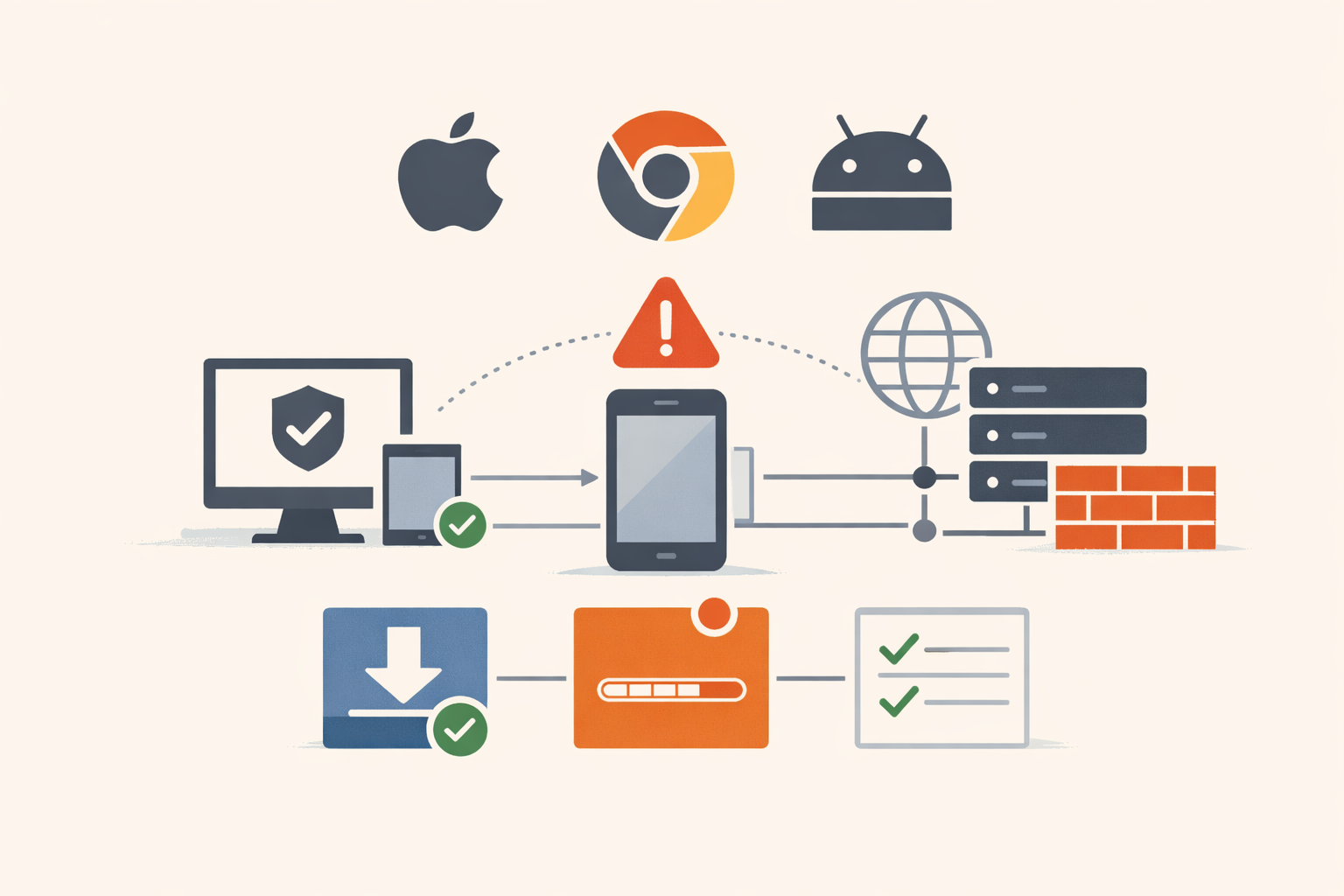
A large slice of the catalog is browser and mobile-OS zero-days: Apple iOS/macOS and WebKit, Google Chrome and Android, Samsung, and Qualcomm chipset bugs. Read them together and two facts stand out. First, they’re overwhelmingly exploited as zero-days, fixed in emergency updates after being caught in the wild. Second, a large share are used by commercial/mercenary spyware (Pegasus, Predator, and the like) and nation-state actors against specific high-value targets, journalists, dissidents, executives, not in broad campaigns. The WebRTC/Candiru entry is the template; these are the rest of the genre.
The shape of the threat
- Apple (WebKit + kernel chains). Apple’s catalog entries are typically a WebKit RCE chained with a kernel privilege escalation, delivered by visiting a malicious page or a zero-click message, used to install spyware. Apple ships emergency Rapid Security Responses and point updates for these, often within days, and has built Lockdown Mode specifically to shrink this attack surface for targeted individuals.
- Google Chrome (V8 + WebKit/Blink). Chrome’s exploited zero-days cluster in the V8 JavaScript engine and the rendering/graphics paths. Chrome auto-updates aggressively, so most users are protected almost immediately; the risk pocket is managed fleets that pin or delay browser updates.
- Android, Samsung, Qualcomm. Mobile-OS and chipset bugs (kernel, GPU, baseband, media frameworks) round out the set, again largely targeted, again fixed through the monthly Android/vendor security updates, with the perennial complication that update delivery on Android depends on the device maker and carrier.
The common defensive truth: these are real, but for the typical organization they are a “keep everything updated” problem, not a per-CVE emergency, because exploitation is targeted and the vendors patch fast.
What to do
For the general case:
- Keep browsers and mobile OSes on automatic updates and current. This is the single highest-value control, and it’s mostly free. Chrome, iOS, and macOS auto-update fast; the failure mode is enterprise policy that delays browser/OS updates. Don’t be the managed fleet sitting on a patched-weeks-ago browser zero-day.
- Enforce timely mobile updates via MDM. Require minimum OS versions, and prioritize device makers with good update track records, since Android patch delivery varies widely.
- Inventory what embeds the browser engine. WebKit and Chromium are bundled in many apps; a browser-engine bug reaches more than the browser.
For high-risk users and the organizations protecting them (journalists, activists, executives, anyone a nation-state might target):
- Enable the hardened modes. Apple’s Lockdown Mode and the equivalent browser protections meaningfully reduce the targeted-spyware attack surface.
- Treat targeted-threat protection as a distinct program. Mercenary spyware is a different adversary than commodity malware; threat-model for it, keep devices current religiously, and engage specialists where the risk warrants.
The reframe is to read the exploitation context, not just the severity. A WebKit or V8 zero-day sounds alarming, and it is, for the specific people it’s aimed at. For everyone else, it’s the strongest possible argument for fast auto-update, which is exactly why turning auto-update on and leaving it on is one of the best security decisions an organization makes. For the people these exploits actually target, it’s a reminder that the threat is real, expensive, and personal, and that the hardened modes exist for them. We flag the browser and mobile entries the day they land and note when mercenary spyware is the operator, because that context decides who needs to worry and how much.
Sources
Share
Related field notes
-
A browser bug, sold as a weapon, pointed at journalists
CVE-2022-2294 was a heap overflow in WebRTC, the real-time-comms code inside Chrome and other browsers. It wasn't used for mass crime. A surveillance vendor, Candiru, used it to plant DevilsTongue spyware on journalists in the Middle East. Different threat model, same patch.
-
Before MOVEit and GoAnywhere, Cl0p's playbook was born on a 20-year-old Accellion box
The Accellion FTA breaches of late 2020 are where Cl0p's mass-data-theft-and-extortion model started. Four CVEs in a legacy file-transfer appliance, exploited to steal data from dozens of organizations. The product was already two decades old and on its way out.
-
Your attack surface isn't just port 443
CVE-2023-46604 is a perfect-10 RCE in Apache ActiveMQ. The exploit isn't a web request; it's a single message to the broker on port 61616, a port most web-focused scanning and firewalling never considers. The broker then fetches a remote XML file and runs whatever's in it.
One email, every weekday morning.
You're in. Check your inbox.